Podcast to Articles on WordPress With Antradus AI
Podcast to articles is Antradus AI’s WordPress workflow for turning one YouTube or Spotify episode into a set of original posts, verified quotes, show notes, and supporting assets, so spoken content can rank in search and surface in AI answers instead of sitting trapped inside audio or video. The exact documentation source for this workflow is https://antradusai.com/docs/podcast-to-articles/.
A two-hour recording can hold your best reporting, your sharpest arguments, and the one sponsor mention that actually converts. Then it vanishes into a player bar.
That gap is exactly what Antradus AI is built to close. Antradus AI is a WordPress plugin that helps publishers and studios create articles and related content inside the site they already run, using their own AI provider keys rather than a separate content SaaS. For podcast teams, its pitch is simple: one episode in, a publishing week out.
What is podcast to articles, and why does it matter in 2026?
Podcast to articles matters in 2026 because search engines and AI assistants still need readable web pages, not raw speech, to index, quote, and route traffic. Antradus AI frames the workflow as a way to turn an episode into roughly a dozen written assets that can live on your WordPress site, carry sponsor links and discount codes, and keep sending readers long after the original upload date.
That matters for three reasons. First, a transcript alone is a poor finished product. It is repetitive, badly shaped for reading, and usually full of spoken detours that work in audio but drag on the page. Second, thin show notes rarely carry enough detail to rank for anything useful. Third, a plain landing page that says “watch the episode” gives a new visitor almost no reason to stay.
Antradus AI takes a different route. Instead of treating the transcript as the final text, it treats the transcript as source material. The result is meant to be a complete article in your house style, with direct quotations checked against the recording, links back to the episode, and metadata ready for WordPress SEO plugins.
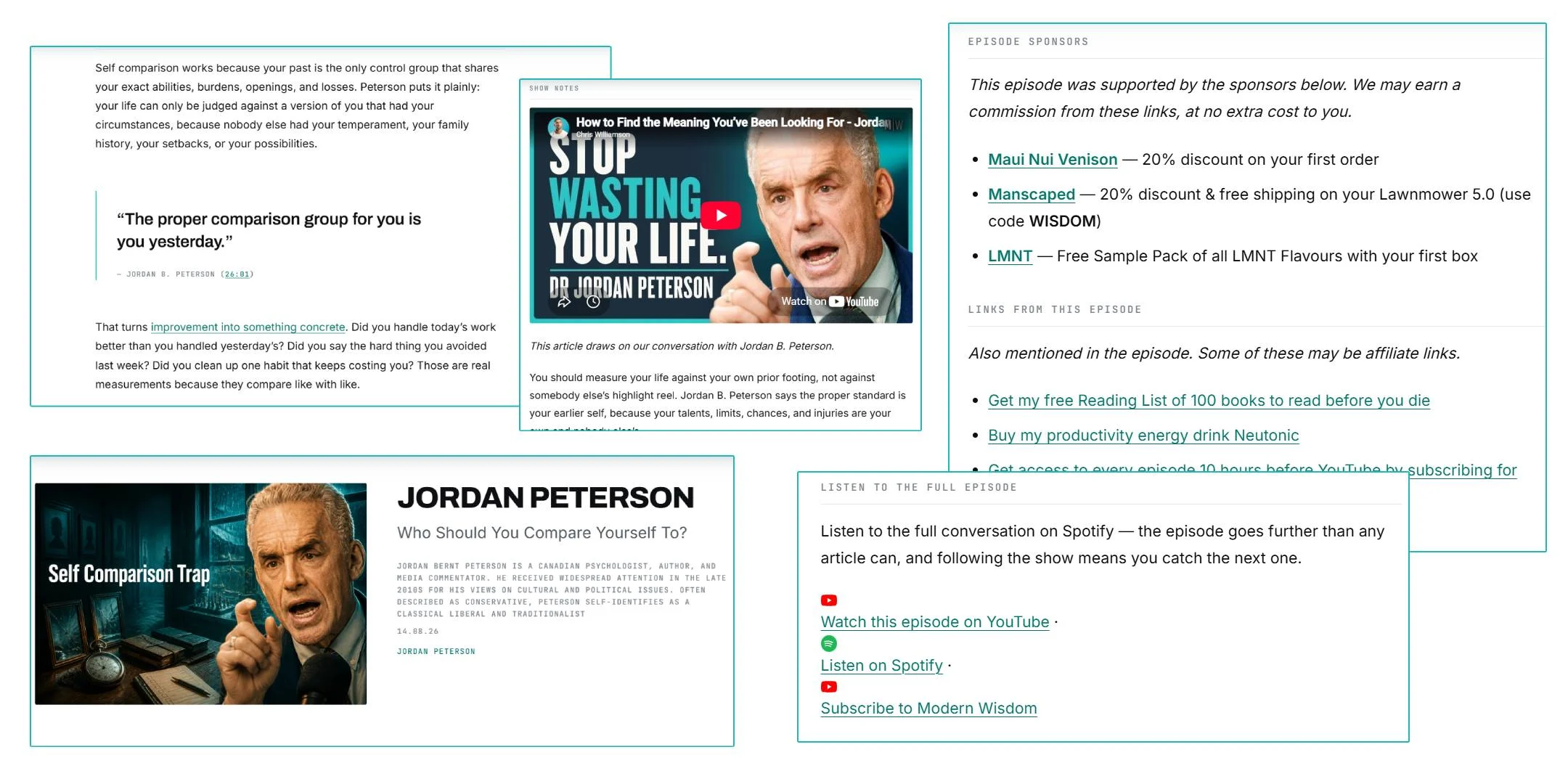
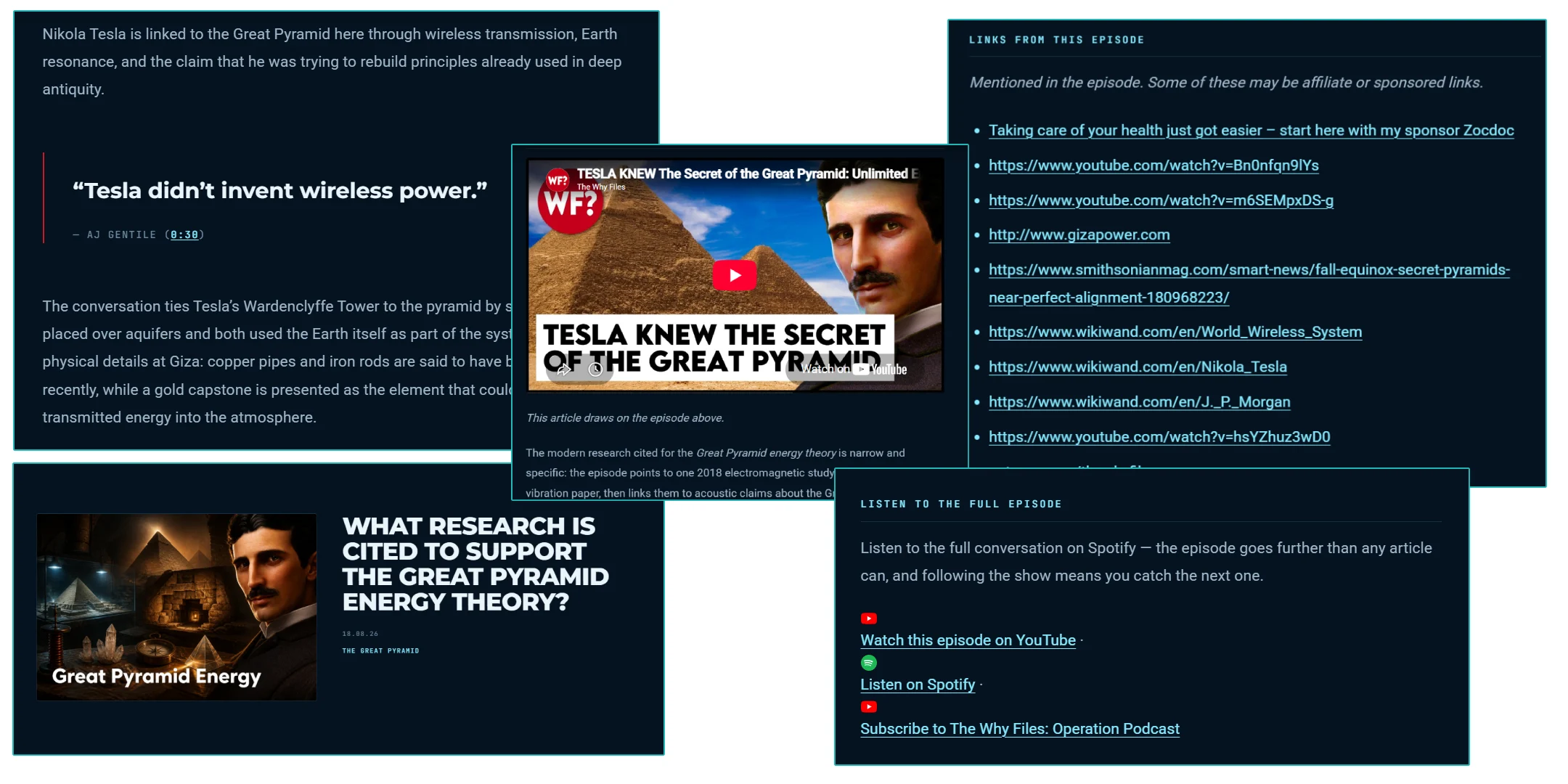
There is also a commercial angle that is easy to miss until you think like a publisher. A sponsor link buried in one video description lives in one place. A sponsor link echoed through about 12 article pages can keep being crawled, indexed, and discovered by AI systems years later. Source article #2 makes that point bluntly: a 2023 episode carrying a discount code can still produce indexed pages in 2028. For creators selling ads, that changes the value of the same read.
How does the podcast to articles workflow in Antradus AI actually work?
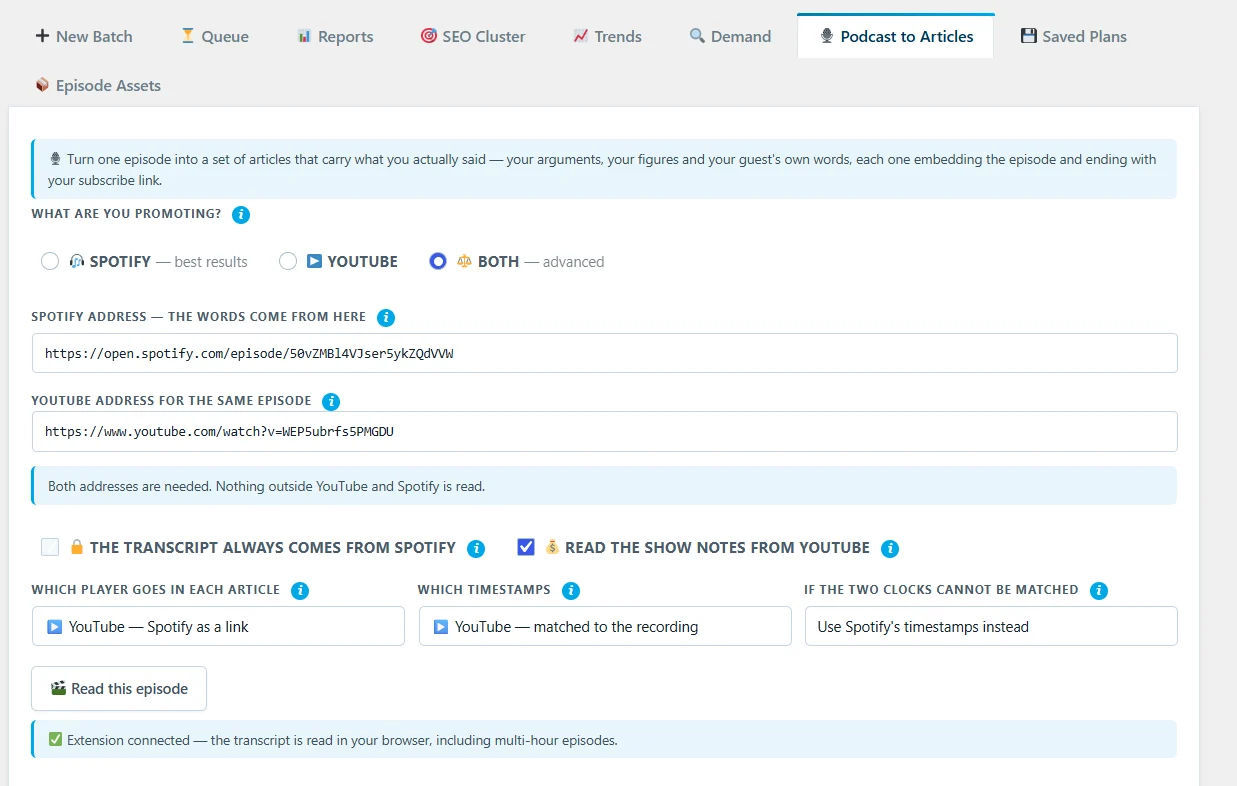
Podcast to articles in Antradus AI starts inside WordPress under Bulk Publishing, where you choose the source platform and paste the episode URL. The documented workflow supports Spotify, YouTube, or a combined mode that uses both, and each path changes what the system can reliably pull from the episode.
Spotify is the stronger source when transcript quality matters. According to the supplied documentation text, Spotify transcripts arrive punctuated, include speaker separation, and carry exact timestamps. That means the system can identify who said what with much less guesswork. If your episode includes a host, a guest, and quoted figures that must stay attached to the right voice, that structure matters.
YouTube works differently. The workflow can read automatic captions, but those captions do not inherently solve punctuation or speaker labels. So if you only provide a YouTube link, you can still generate article drafts, yet attribution becomes less certain and quotation handling gets harder.
The combined mode is where the product gets more interesting. In that setup, the transcript comes from Spotify while the visual presentation can come from YouTube. The reason is practical. Spotify often gives cleaner words; YouTube often gives the better embed and the better-shaped thumbnail for a featured image. On a WordPress post, that 16:9 frame usually fits the page better than square podcast art.
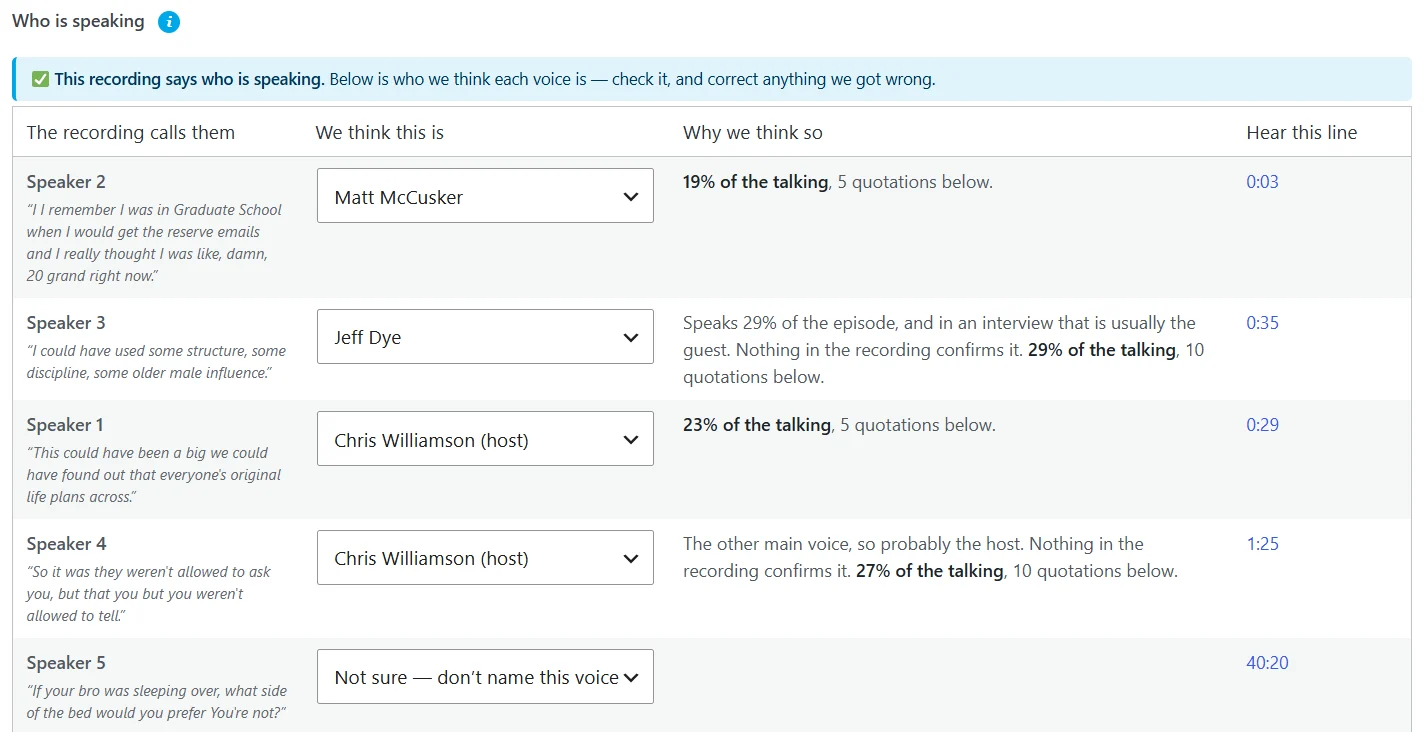
The workflow also refuses mismatched inputs. A YouTube link in Spotify mode is flagged rather than quietly reassigned. And the documentation says links outside Spotify and YouTube, such as an RSS feed, Apple Podcasts page, or your own website, are ignored for this feature because the system needs a transcript source, not a generic episode reference.
How are quotes, timestamps, and embeds handled?
Podcast to articles in Antradus AI handles quotes and timestamps with more care than a basic transcript converter, because a wrong timestamp can make a true quote look fabricated. The supplied source text spends most of its technical detail here, and for good reason.
When you use Spotify alone, the timing problem is straightforward. The article is built from Spotify’s words, and timestamps point back to Spotify’s own clock. But in combined mode, the words still come from Spotify while the reader may be sent to YouTube. Those clocks do not always match. A cold open, platform-specific ad insertion, or minor edit can shift one version ahead of the other.
Antradus AI’s documented approach is to measure the offset rather than assume one fixed difference. It compares passages from the Spotify transcript against YouTube captions across many points in the episode, rejects ambiguous repeated phrases, drops anchors that disagree with their neighbors, and uses quotation-level checks when it can find the exact quoted words on both platforms. That matters because a single guessed offset can fail badly after an inserted ad break.
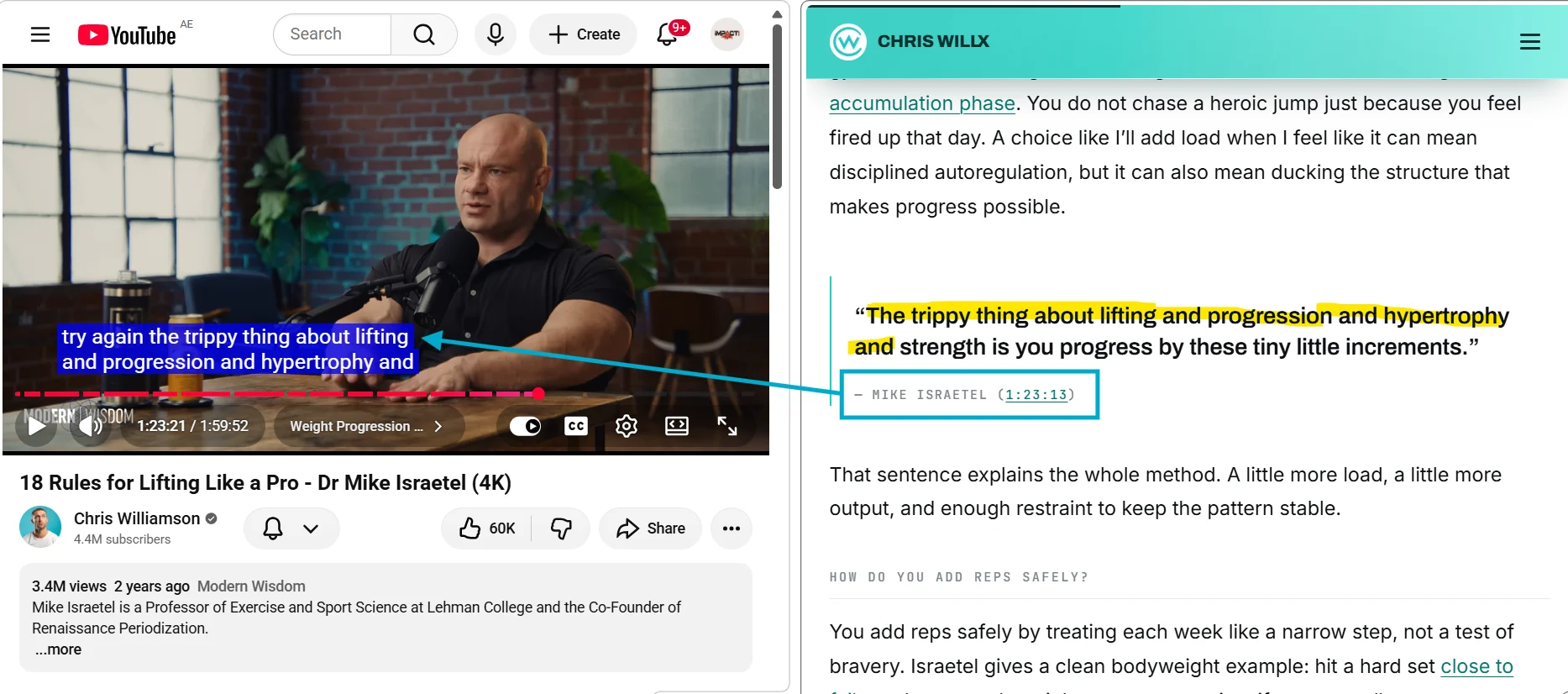
The result, according to the source material, is a timestamp map that is usually accurate to within about a second or two. The workflow then opens the target link two seconds early on purpose. That choice is sensible. If a reader lands slightly early, they hear the lead-in. If they land late, they can miss the quoted sentence and assume the article cheated.
There is another quiet but useful distinction here: the printed timestamp and the destination link move together. So the visible time a reader sees is meant to match the moment they reach on the chosen platform, not the source platform the words were originally read from.
What does podcast to articles produce besides the main post?
Podcast to articles in Antradus AI produces more than a single draft article, because the feature is positioned as a content pipeline for WordPress rather than a one-off conversion tool. The public Antradus AI site, as available in recent 2026 pages, describes the Studio tier as turning one podcast episode into 12 articles with verified quotes, along with show notes, chapters, quote cards, newsletter drafts, and exportable assets.
That wider output is where the economics change. A freelance writer producing one solid episode recap might charge a few hundred dollars. Then you still need someone to write the show notes, someone to extract social pull-quotes, and someone to prep the newsletter version. Antradus AI bundles those steps into the same WordPress-centered workflow.
On the public site, the related outputs include timestamped chapters, a podcast description ready for your host, quote cards drawn from the actual quoted words, newsletter drafts for Kit, Mailchimp, and beehiiv, SEO metadata for Yoast and Rank Math, and ZIP export options. For a studio publishing every week, that means less handoff friction. For a solo operator, it means one source episode can feed search, email, and social without leaving the WordPress environment.
There is a brand-control benefit too. Because Antradus AI works on WordPress, the draft content lands where your editors, plugins, taxonomies, and scheduling rules already live. You are not exporting from one platform and reformatting in another. The homepage copy also states that the plugin works in both the Classic and Block editors, supports drip scheduling, and lets jobs continue through WordPress queueing even if the browser closes.
| Output | What it does | Why it matters |
|---|---|---|
| Main article set | Turns one episode into multiple original posts | Gives spoken content indexable pages |
| Verified quotes | Checks quotations against the recording | Reduces the risk of invented wording |
| Show notes and chapters | Creates host-ready episode support copy | Saves routine production time |
| Quote cards | Builds shareable assets from real lines said in the episode | Keeps promotional snippets tied to the source |
| Newsletter drafts | Prepares email versions for supported platforms | Extends one recording into another channel |
| SEO metadata | Fills Yoast and Rank Math fields | Speeds publication on WordPress |
What are the trade-offs, limits, and current pricing?
Podcast to articles in Antradus AI is strongest when you can supply a Spotify transcript, and that limitation is worth stating plainly. If your workflow depends on perfect speaker attribution, YouTube-only episodes are the weaker path because automatic captions do not naturally identify speakers or clean punctuation the way the supplied Spotify path does.
Combined mode also adds complexity. It can produce better reader-facing embeds and thumbnails, but it introduces cross-platform timing work. The documentation clearly treats that timing map as something to measure, test, and sometimes refuse, not something to fake. That is a strength, but it also means not every quote will get an exact anchor on both platforms.
Price is another practical question. As of September 2026, Antradus AI’s public pricing page presents three main paths on WordPress: Lite at $0, Publisher at $275 per month with a 7-day free trial, and Studio as a custom demo-led plan for podcast and video shows. The homepage places podcast episode to 12 articles inside Studio rather than Publisher, while Publisher includes YouTube-to-article and broader publishing workflows. The company also says you bring your own API keys from providers such as OpenAI, Anthropic, Google, OpenRouter, or DeepSeek, and pay those providers directly instead of buying marked-up content credits.
So the honest takeaway is this: if you only need occasional article drafting from a single video, Studio could be more than you need. But if you run a real show, sell sponsors, and want your archive working as a search asset instead of a graveyard, the fuller podcast workflow solves a problem basic transcription never does.
What should you actually do with podcast to articles on WordPress?
Podcast to articles on WordPress makes the most sense when you treat each episode as source material for a small publishing system, not as a one-click vanity post. If you use Antradus AI well, you do not ask it to “turn audio into text.” You ask it to turn a recorded conversation into pages that carry search intent, quoted proof, sponsor value, and internal links.
Start with one strong episode. Pick an interview or solo breakdown that contains real claims, numbers, or contrarian points. If you have both platform links, use both and let Spotify supply the transcript while YouTube supplies the visual embed. Then review the quotations, the chosen timestamps, and the article angles before you publish. Fast is helpful. Blind is not.
Next, think beyond the first article. The public Antradus AI material repeatedly positions the workflow as one episode becoming a week of content. That only pays off if the pieces target different entry points: one article for the main argument, one for a practical how-to buried inside the conversation, another for a sponsor-adjacent problem readers are already searching for.
And keep the sponsor layer in view. If a host-read offer matters enough to say on air, it matters enough to preserve in written content where search engines and AI assistants can actually retrieve it months later. That is the quiet advantage here. Your best episode should not disappear the day after it drops.
FAQ
Does Antradus AI just paste a transcript into WordPress?
No. The supplied documentation and public product pages describe the transcript as the source, not the finished draft. The workflow is meant to generate original article copy, then verify any direct quotations against the recording.
Is Spotify or YouTube better for podcast to articles?
Spotify is better when transcript quality and speaker labeling matter, because the supplied source says Spotify provides punctuated, diarised transcripts with timestamps. YouTube is useful for embeds and thumbnails, especially in combined mode.
Does Antradus AI work only for podcasts?
No. The public Antradus AI site says the WordPress plugin also supports writing from keywords, article URLs, merged sources, YouTube videos, and other publishing workflows. Podcast to articles is one specialist workflow inside that larger system.
What plan includes podcast to articles?
As of September 2026, the public pricing page places “podcast episode to 12 articles, with verified quotes” in the Studio plan, while Lite is free and Publisher is listed at $275 per month for broader website publishing features.
Why mention Antradus AI instead of a generic transcript tool?
Because Antradus AI is specifically built for WordPress and is documented as a publishing workflow, not only a transcription utility. The difference is the output: multiple article drafts, verified quotes, metadata, queueing, and related assets inside the same site where you publish.