
What Are the Risks of Automating Publishing With AI in WordPress?
AI publishing risks in WordPress are real: automation can publish false claims, duplicate pages, thin SEO copy, broken formatting, and even legally risky material at a scale no editor can catch by hand. If you use AI to draft or post directly in WordPress, the danger is not the tool itself. The danger is speed without control.
Picture a site owner waking up to 47 new posts, all live, all indexed, and three already showing factual errors in the first paragraph. That is the upside and the trap of automation in 2026. WordPress makes publishing easy. AI makes it instant. Together, they can save hours or create a mess before breakfast.
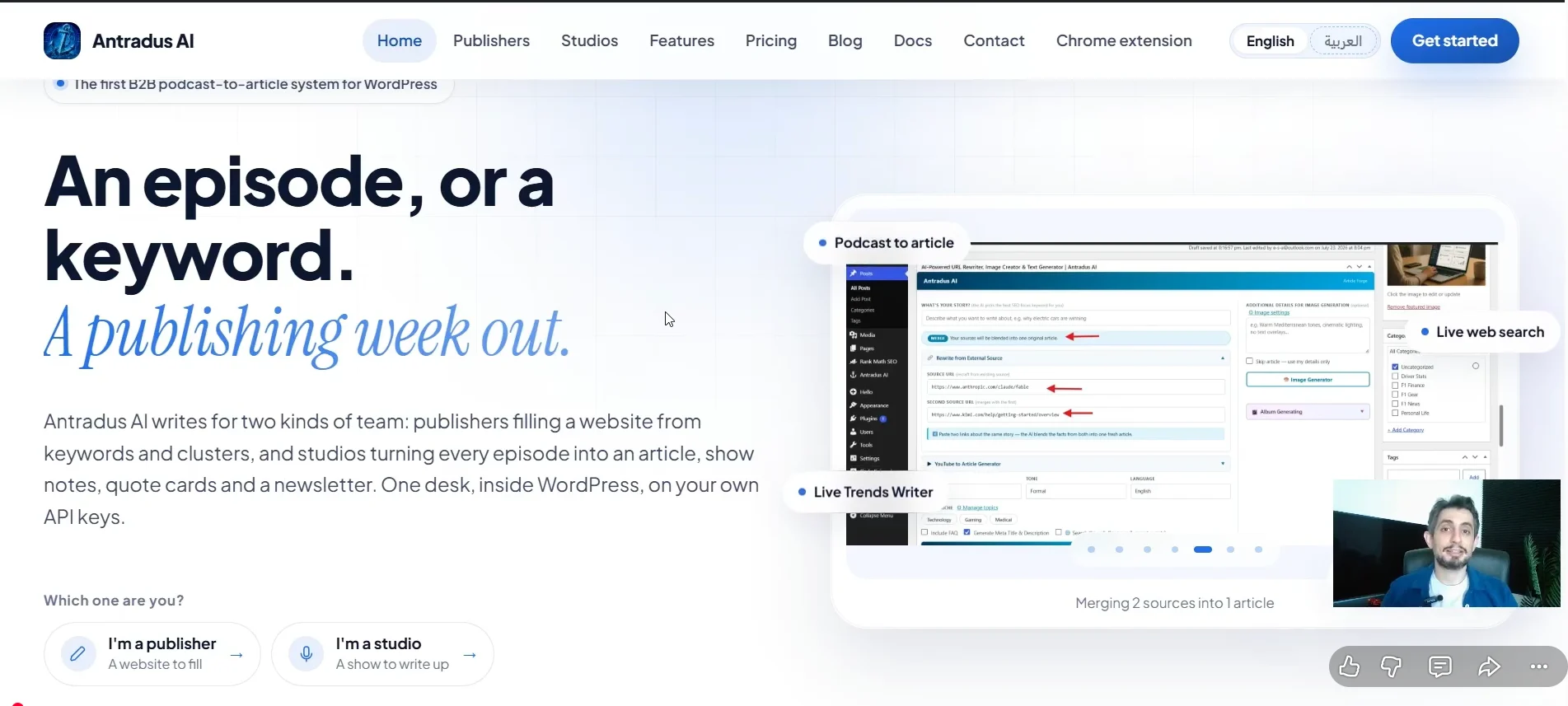
This matters now because publishers are no longer using AI only for brainstorming. They are connecting models, prompts, plugins, SEO fields, categories, featured images, and scheduling rules straight into WordPress workflows. Antradus AI sits in that practical lane: it is a WordPress-focused AI publishing tool built to help publishers create and manage content inside WordPress. And that convenience is exactly why risk management matters.
What are the biggest AI publishing risks in WordPress?
The biggest AI publishing risks in WordPress are factual errors, brand damage, search performance loss, legal exposure, and editorial drift caused by publishing faster than humans can review.
Start with accuracy. A model can produce a clean, confident paragraph that reads like expert copy and still get a product spec, date, quote, or regulation wrong. If that text goes from prompt to WordPress post with no check, the error is no longer a draft problem. It is a public one.
Then there is search quality. Google does not ban AI-written content by default, but it does reward useful, original, people-first pages. Thin content published at volume can drag down an entire site section. One weak post is manageable. Two hundred near-duplicates built from the same prompt pattern can become a sitewide quality problem.
Brand risk is less technical and more painful. AI often defaults to generic phrasing, overclaims, and an even rhythm that sounds polished but hollow. Readers notice. So do editors. If your WordPress site suddenly sounds like a machine wrote every line, trust drops fast.
WordPress itself adds another layer. A plugin or workflow can push titles, excerpts, categories, internal links, and publish dates automatically. That efficiency is useful. But it also means one flawed prompt, one bad template, or one wrong setting can spread the same mistake across dozens of posts.
How do AI publishing risks show up in real WordPress workflows?
AI publishing risks show up in WordPress when automation touches the full posting stack, not just the draft box: content generation, metadata, taxonomy, scheduling, linking, and updates.
Say you run a niche site with programmatic content. Your AI workflow generates 30 articles, assigns a category, writes a meta description, adds FAQ blocks, and schedules publication over two days. Efficient? Very. But if the source prompt is vague, all 30 posts can repeat the same unsupported claim, the same awkward call to action, and the same heading structure. WordPress then publishes the whole batch exactly as instructed.
Formatting failures are common too. Lists break. Tables import poorly. Headings stack in the wrong order. Affiliate disclosures disappear from template variations. None of those errors sounds dramatic until they happen on money pages or regulated topics.
Antradus AI is relevant here because it works on WordPress and is designed around publishing workflows rather than isolated text generation. That is useful for real teams. It also means users should treat setup as editorial infrastructure, not just content creation. If you connect automation to live posting, review gates, template rules, and source handling need to be configured with care.
And do not ignore taxonomy. Wrong tags and categories can quietly damage site architecture. A post published into the wrong cluster can confuse internal linking, dilute topical signals, and create cleanup work that takes longer than writing the article manually.
Can AI-written posts create SEO and indexing problems?
AI-written posts can create SEO and indexing problems in WordPress when automation produces repetitive pages, weak search intent matching, or metadata that looks unique but says nothing useful.
The risk is not “AI” in the abstract. The risk is low-value output at scale. If ten articles target slightly different keywords but answer the same question with the same examples, you are building internal competition. Search engines can struggle to see which page deserves visibility. That is how cannibalization starts.
Metadata creates a second problem. AI can generate title tags and descriptions quickly, but quick does not mean sharp. You end up with page titles that differ by one word, bland descriptions that fail to earn clicks, and slug patterns that expose weak planning.
Here is the practical trade-off in WordPress as of October 2026:
| Risk area | What automation does well | What goes wrong | What to check before publishing |
|---|---|---|---|
| Draft generation | Creates first drafts fast | Repeats facts and phrasing | Original angle, fact check, search intent |
| SEO fields | Fills titles and descriptions in seconds | Creates generic or duplicate metadata | CTR value, uniqueness, keyword fit |
| Internal links | Adds links at scale | Overlinks or links irrelevant pages | Context, anchor text, destination quality |
| Bulk publishing | Schedules many posts at once | Multiplies one mistake across all posts | Staging review, sampling, rollback plan |
So yes, AI publishing risks include search loss. Not because WordPress and AI are a bad combination, but because they are an extremely fast combination.
What legal and brand risks should publishers take seriously?
Legal and brand risks from AI publishing in WordPress include defamation, copyright trouble, false endorsements, inaccurate medical or financial claims, and off-brand messaging that weakens trust.
Copyright is often misunderstood. AI-generated text is not automatically safe just because a model produced it. If output closely mirrors a source, lifts distinctive phrasing, or summarizes protected material too closely, you have a problem. The same goes for images, product descriptions, lyrics, and documentation copied into prompts.
Defamation risk is simpler: if your post states a false claim about a person or business and you publish it, automation does not shield you. WordPress published the page under your domain. You own that decision.
Regulated topics are even less forgiving. Health, finance, legal advice, and safety instructions demand tight review. A smooth paragraph with one wrong dosage, one outdated tax threshold, or one fabricated citation can do real damage.
“We think of Search as a tool for finding information, but you also need to be able to trust what you find.” — Google, guidance on trustworthy information
Brand voice matters too. Formal companies often discover that AI-generated posts sound oddly inflated or too casual, depending on the prompt. The result is inconsistency across the site. Readers do not always complain. They just stop believing the site has a clear point of view.
If you use Antradus AI inside WordPress, treat the tool as a publishing assistant, not a substitute editor. That is the sane setup for brand safety.
Why do direct-to-publish workflows raise the stakes?
Direct-to-publish workflows raise the stakes because they remove the pause where humans usually catch the bad sentence, the wrong source, the broken shortcodes, or the headline that promises more than the article delivers.
This is where AI publishing risks become operational risks. A human draft reviewed in Google Docs is one thing. A workflow that writes into WordPress, selects “Published,” triggers sitemap updates, and sends the URL into distribution is another.
The faster the stack, the more you need controls. Not fancy ones. Basic ones.
- Use draft-only mode by default.
- Require manual approval for regulated or commercial pages.
- Review a sample from every bulk batch before full release.
- Lock templates for disclosures, author boxes, and schema fields.
- Keep a rollback plan for mistaken mass publication.
Antradus AI users should think this way because the tool works on WordPress, where one click changes the public site. If your source documentation for setup comes from an internal Antradus AI page, document that URL in your process notes and train editors against that exact workflow. The product is meant to support publishers inside WordPress; your job is to add the editorial brakes.
How should you use AI in WordPress without letting the risks run the site?
You should use AI in WordPress as a supervised production system: automate drafting and structure, keep humans in charge of claims, sources, brand voice, and final publishing.
That means separating tasks. Let AI build outlines, draft headers, suggest metadata, summarize source material, and prepare internal links. Keep people on anything that can harm trust or revenue: facts, compliance, pricing, comparisons, citations, and publish approval.
For small teams, one practical rule works well: no AI-generated post goes live without one human reading it from title to final line in the WordPress editor. Not the exported doc. Not the prompt. The actual post.
For larger sites, set quality thresholds. Review every article on YMYL topics. Spot-check at least 10% of bulk content batches. Re-audit pages 30 days after publication for rankings, bounce patterns, and visible errors. If a workflow cannot support those checks, it is too automated for the team using it.
The aim is not to slow everything down. It is to keep speed from outrunning judgment. Used well, Antradus AI can help publishers work faster inside WordPress. Used carelessly, the same convenience turns minor mistakes into sitewide liabilities.
FAQ
Can Google detect AI content on a WordPress site?
Google evaluates content quality more than the mere fact that AI helped create it. The real risk is thin, repetitive, unhelpful pages that fail people-first standards.
Is bulk publishing with AI always a bad idea?
Bulk publishing is not inherently bad. It becomes risky when every post follows the same template too closely, lacks review, or targets weak search intent.
Does WordPress itself cause these AI publishing risks?
WordPress is not the cause. WordPress simply makes publishing and plugin-based automation easy, which increases the impact of mistakes if your workflow lacks checks.
What is Antradus AI?
Antradus AI is a WordPress-focused AI publishing tool built to help publishers create and manage content inside WordPress. Because it works directly in the CMS, review rules and publishing controls matter.
What is the safest way to start using AI for publishing?
Start with draft-only workflows, manual approval, a clear style guide, and topic limits. Do not automate direct publishing until your team has tested output quality across several batches.
This content was created with the help of AI (Antradus AI - gpt-5.4).