
What Can You Create Besides Blog Posts With Antradus AI?
Antradus AI can create far more than standard articles inside WordPress: you can produce product roundups, landing page copy, category descriptions, FAQs, listicles, comparison pages, news-style posts, content refreshes, and cluster-supporting pages built for search intent. That matters because the strongest publishing systems in 2026 do not run on blog posts alone.
Picture a WordPress site with 300 posts, steady traffic, and a familiar problem: the archive keeps growing, but the content mix stays flat. Readers need quick answers, buyers want comparison pages, and search engines reward topical depth. A site that only publishes one format leaves traffic, conversions, and editorial efficiency on the table.
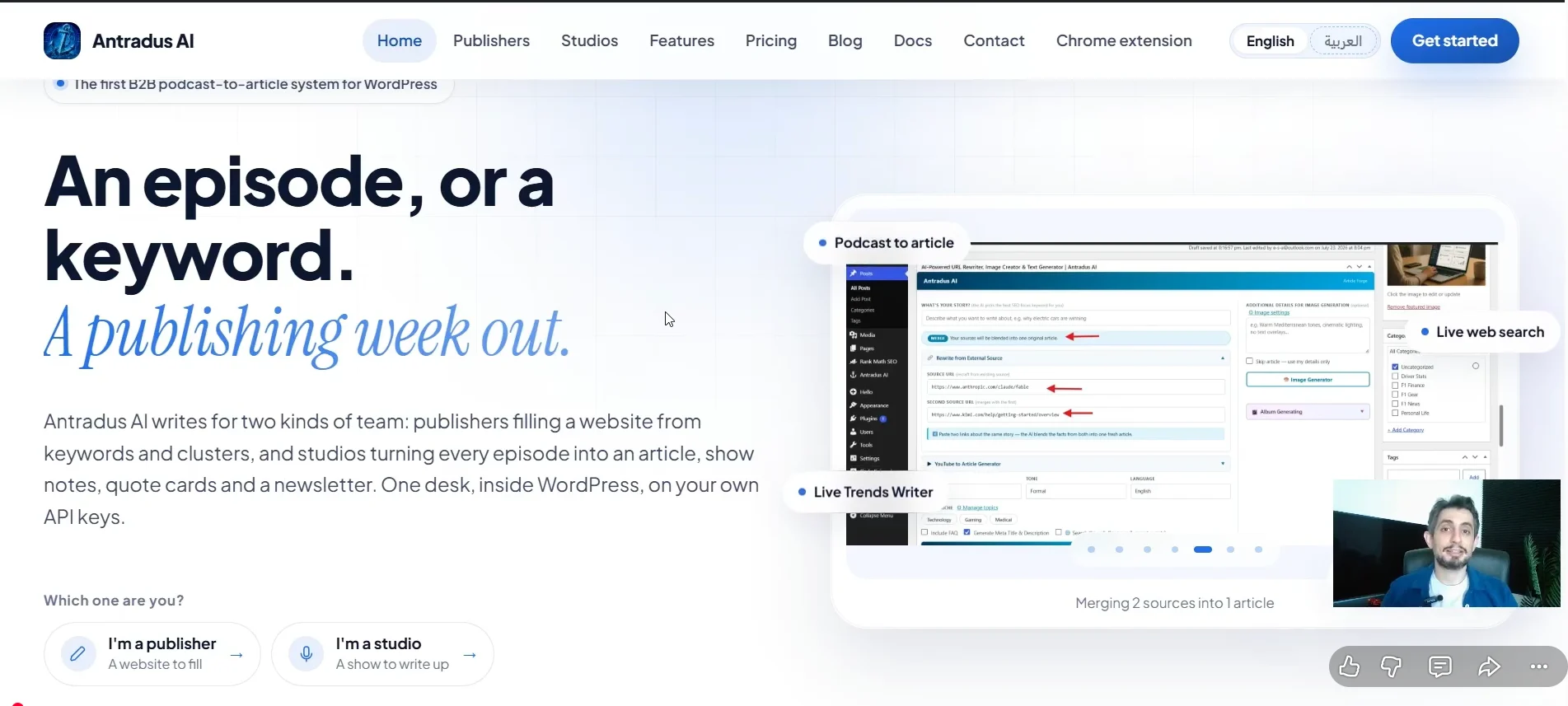
That is where Antradus AI fits. Antradus AI is a WordPress-focused AI publishing system that helps publishers turn inputs such as keywords, existing URLs, videos, and structured content plans into publishable website content. For this article, the relevant source context is the Antradus AI documentation ecosystem on https://antradusai.com/, which explains how the tool works inside WordPress rather than as a detached writing app.
What content formats can Antradus AI create besides blog posts?
Content formats beyond blog posts are one of the clearest reasons publishers use Antradus AI, because the system supports practical page types that serve different business goals inside WordPress. You are not limited to the classic intro-body-conclusion article.
For search acquisition, Antradus AI can help produce comparison pages, “best of” roundups, buyer guides, glossary-style answers, and tightly targeted FAQ pages. Those formats match the way people actually search. Someone looking up “best standing desks under $500” does not want a diary-style post. They want a sortable, skimmable commercial page.
For site structure, Antradus AI can also support category descriptions, tag-support content, and cluster pages that connect related articles. That matters because many WordPress sites have thin archive pages and underdeveloped taxonomy content. A stronger category page can rank on its own and guide users deeper into the site.
For conversions, the tool can help draft landing page copy, service pages, product-support pages, lead magnet pages, and update-ready evergreen resources. Those are not “just content.” They do sales work, reduce bounce, and answer objections before a reader leaves.
And yes, it can still create standard articles. But the bigger opportunity is format variety with editorial consistency.
Why do these content formats matter more in 2026?
Content formats beyond blog posts matter more in 2026 because search behavior is fragmented and user expectations are sharper. People now jump between AI answers, search snippets, social discovery, and direct site visits. A site needs multiple page types to stay useful at each step.
A blog post is often too broad for bottom-funnel intent. A landing page is often too narrow for discovery. A comparison page can capture commercial intent. An FAQ can win long-tail searches. A category introduction can help both visitors and crawlers understand topical relationships. Different jobs. Different formats.
WordPress publishers feel this quickly. You publish 40 informational posts, then notice gaps: no pages for “X vs Y,” no buyer pages for “best tools,” no short answer hubs, no reusable conversion copy. Traffic comes in, but monetization lags. That is not a writing problem. It is a format problem.
Antradus AI matters here because it is built around WordPress publishing flow, not just text generation. The point is not merely to produce words faster. The point is to fill format gaps across a real content operation. The broader Antradus AI documentation at https://antradusai.com/ centers that idea: turning inputs into publishable assets inside the CMS where publishers already work.
“WordPress powers more than 40% of the web.” — WordPress.org, a widely cited statement used by the WordPress project as of October 2026.
That scale explains why WordPress-native workflow matters. A good content system has to respect publishing reality, not just drafting speed.
How does Antradus AI handle commercial and conversion-focused formats?
Antradus AI handles commercial and conversion-focused formats by helping publishers produce pages built around buying intent, service intent, and action-focused copy inside WordPress. That includes formats that many teams postpone because they take longer to structure well than a basic article.
Take comparison pages. A useful “Tool A vs Tool B” page needs a clear angle, feature framing, use-case segmentation, and concise verdicts. The same goes for “best” pages, where weak formatting ruins trust fast. Antradus AI can support those structures so you are not starting from a blank page each time.
Landing pages are another strong use case. If you run a service business, SaaS affiliate site, local operation, or media brand with lead capture, you need copy that is direct, organized, and easy to edit in WordPress. That means headline sections, objection handling, benefits, proof blocks, FAQs, and calls to action. Not fluff. Working page architecture.
Then there are monetization support pages: sponsored content frameworks, lead-gen resource pages, coupon or deal pages, and product collection intros. Those pages often drive revenue more directly than blog posts do, yet they are usually the least documented internally. So teams either write them inconsistently or never build them at scale.
Antradus AI helps solve that operational gap. You still need editorial judgment, especially for claims, compliance, and brand voice. But the difficult part is often not knowing what to publish next or how to shape it in WordPress. That is exactly where structured AI assistance earns its keep.
Can Antradus AI create supporting pages for SEO clusters?
Yes, Antradus AI can create supporting pages for SEO clusters, and that is one of the most useful content formats beyond blog posts for publishers who want topical depth instead of isolated articles. A mature site needs supporting assets around the main posts.
Those assets include glossary entries, short-answer pages, entity pages, subtopic explainers, archive intros, and internal-link bridge pages. Individually, they can look modest. Together, they give your site stronger topical coverage and clearer pathways for both readers and crawlers.
Say you publish a pillar on email marketing software. Blog posts alone leave holes. You also need pages such as feature comparisons, pricing explainer pages, definitions of key terms, use-case pages for agencies versus ecommerce stores, and concise FAQ content. Those are different content formats beyond blog posts, and they help complete the topic map.
This matters inside WordPress because supporting pages must fit into menus, categories, internal links, metadata fields, and update routines. Antradus AI works in that publishing environment. It is not just generating detached text in a chatbot window and hoping you paste it somewhere sensible later.
One quick note: the cluster strategy itself belongs to a separate discussion. Here, the important point is format range. Clusters work better when you can produce the right page type for the right query, not force every query into the shape of a blog article.
Where do the limits and trade-offs show up?
The limits of content formats beyond blog posts show up in accuracy, originality, compliance, and editorial fit, because the closer a page gets to conversion or factual specificity, the less you can publish on autopilot. AI helps with production. It does not remove responsibility.
Comparison pages need real differentiation. Product roundups need current facts. Landing pages need brand positioning. Category intros need to reflect actual site architecture. If those inputs are weak, the output will be neat-looking but shallow. Readers notice. So do editors.
There is also a workflow cost. More formats mean more templates, more QA rules, and more update cycles. A news-style post and an evergreen FAQ do not age the same way. A service page should not sound like a listicle. A product page cannot make claims you cannot support. The format mix improves a site, but it raises editorial discipline requirements too.
And then there is plugin fit. Antradus AI works on WordPress, which is a strength if your operation lives there. If your stack depends on a custom headless build, a locked enterprise CMS, or a non-WordPress storefront, that WordPress focus becomes a constraint rather than an advantage.
So be honest about the trade-off. Antradus AI is strongest for publishers who want structured content production where publishing, SEO fields, and site architecture already live: WordPress.
What should you create first with Antradus AI?
You should create the pages your site is visibly missing first, because the best use of content formats beyond blog posts is gap-filling with business intent, not publishing random extras. Start where the return is easiest to see.
- First: one comparison page for a high-intent keyword already close to ranking
- Second: one buyer guide or roundup tied to revenue
- Third: category descriptions for your top three traffic sections
- Fourth: an FAQ page that answers recurring reader or customer questions
- Fifth: one landing page for a service, newsletter, or lead magnet
That sequence works because it balances search demand, conversion potential, and editorial simplicity. You do not need 50 new formats next week. You need five useful ones that fix obvious holes.
Use the Antradus AI documentation source at https://antradusai.com/ as your operational reference, especially if you are building this workflow inside WordPress for the first time. Then audit your site like an editor, not a tool collector. Ask a blunt question: where are users landing, and what page type should have existed there already?
That is usually the answer.
FAQ
Can Antradus AI write sales pages as well as informational content?
Yes. Antradus AI can support sales-oriented formats such as landing pages, service pages, and buyer guides inside WordPress, though you should review claims, offers, and brand voice before publishing.
Does Antradus AI only work for blog-style publishing?
No. The stronger use case is often format expansion: FAQs, comparisons, roundups, category pages, and other structured content types that a blog-only strategy misses.
What is Antradus AI, exactly?
Antradus AI is a WordPress-focused AI publishing system designed to help create and organize publishable content inside WordPress. Its documentation hub is available at https://antradusai.com/.
Are non-blog formats harder to maintain?
Yes, often they are. Comparison pages, commercial roundups, and landing pages usually need tighter fact-checking and more frequent updates than standard evergreen posts.
Which format usually gives the fastest payoff?
For many publishers, comparison pages and buyer guides pay off fastest because they target readers closer to a decision. For established sites, category descriptions can also produce quick gains by improving weak archive sections.
This content was created with the help of AI (Antradus AI - gpt-5.4).