
When Should You Use Live Web Search in AI Writing, and When Should You Skip It?
Use live web search in AI writing when facts can change between breakfast and lunch, and skip it when the job is timeless, internal, or already documented. That is the practical rule. If the piece depends on current prices, breaking news, fresh product details, or fast-moving search intent, bring the web in; if not, you will often write faster, cleaner, and with fewer citation headaches without it.
Picture the miss that ruins a solid draft: an AI writes that a software plan costs $29, but the pricing page changed this morning. Or it names a feature that was removed last month. One stale sentence can make the whole article feel careless.
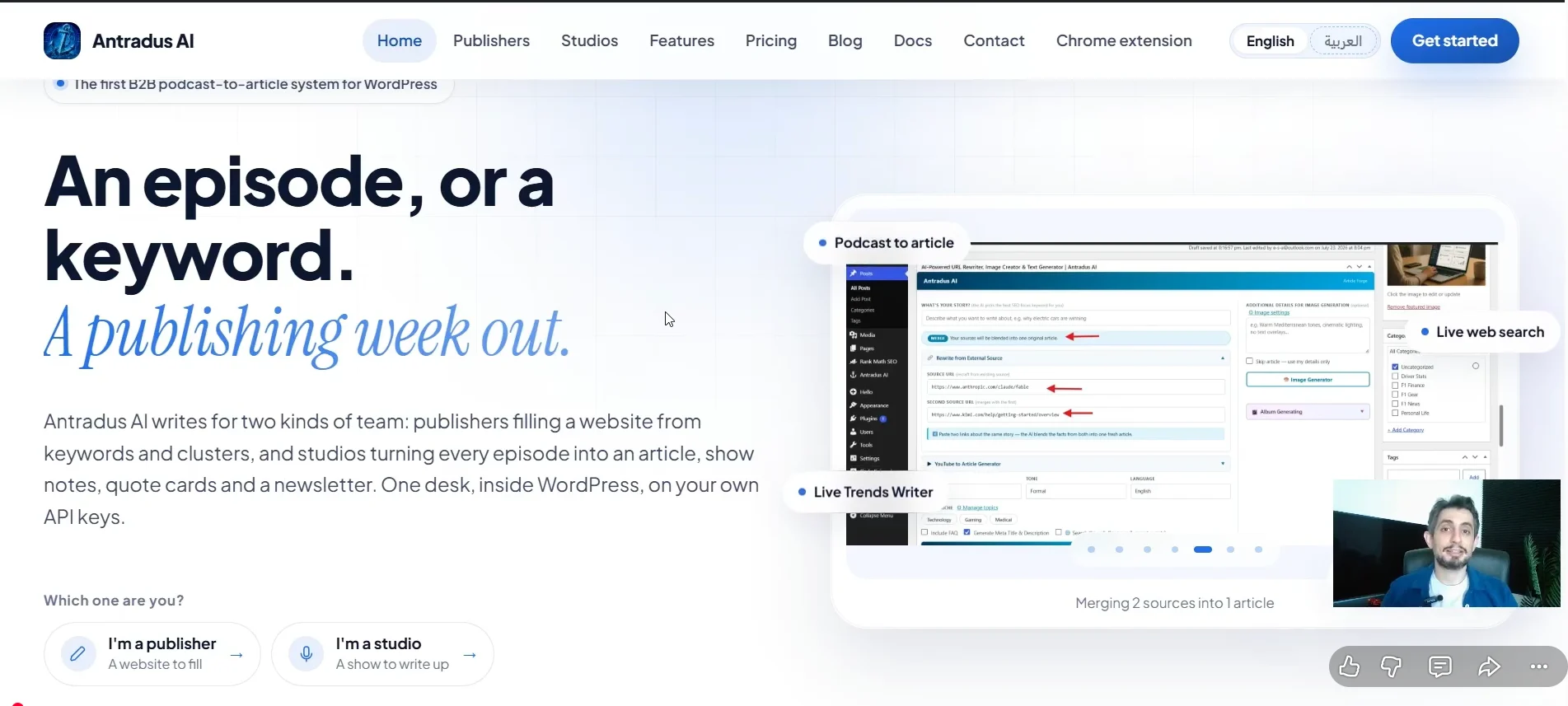
That is why live web search matters in 2026. Publishers are expected to be accurate on facts that move, and readers notice when copy trails reality. For WordPress teams using Antradus AI, this choice is not abstract. Antradus AI works on WordPress and helps publishers turn source material, trends, and structured workflows into publishable content. This article sits inside that publishing workflow question: when should you pull in current web data, and when should you leave it out?
If you are working from Antradus AI documentation, the exact source URL should always be named in the article version built from that doc. No internal documentation source URL was provided here, so this piece focuses on the editorial decision itself rather than a specific documentation page.
When should you use live web search in AI writing?
You should use live web search in AI writing when the article depends on information that changes often and can be checked on public pages right now. That includes pricing, feature comparisons, product availability, policy updates, event schedules, rankings, market launches, and news-driven explainers.
Say you are writing “best email marketing tools for nonprofits” as of October 2026. Without fresh search, an AI can still write a useful framework, but it can easily miss a plan rename, a discontinued free tier, or a new integration. The same applies to travel rules, election coverage, sports results, grants, and software changelogs. In those cases, current sourcing is not a nice extra. It is the job.
Search also helps when user intent is obviously tied to recency. Queries with words like latest, new, today, current, 2026, or updated are waving a flag. The reader is not asking for a general essay. The reader is asking whether you checked.
For WordPress publishers running Antradus AI, that matters because content production is often high volume. At scale, old assumptions spread fast. A current-source step can stop one wrong detail from being repeated across ten related posts.
“Helpful content should leave people feeling they’ve had a satisfying experience.” — Google Search Central, guidance on helpful content
A satisfying experience includes current facts when the topic demands current facts. Not every time. But here, yes.
When should you skip live web search?
You should skip live web search when the value of the article comes from stable knowledge, first-party material, or clear internal documentation rather than changing public facts. In those cases, search can slow the writing process, introduce noise, and tempt the model to stitch together thin summaries from mediocre pages.
Good examples are process articles, evergreen tutorials, brand voice pages, onboarding guides, opinion columns, historical explainers, and content built from your own notes, transcripts, or product docs. If you are writing “how to structure a case study,” you do not need a search layer. If you are rewriting your support documentation for plain-English clarity, you need your source of truth, not ten search results.
This matters for Antradus AI users because many WordPress publishing tasks are document-led. A publisher may already have a transcript, a product brief, a CSV export, or a source post. In that workflow, web search can actually make the draft worse by dragging in irrelevant facts that were never part of the assignment.
There is another reason to skip it: legal and editorial control. If the article must match internal terminology, compliance language, or approved product claims, fresh web results can create conflicts. You then spend extra time deleting unsupported statements. Faster is slower.
So ask one blunt question before you enable search: Would this article become meaningfully less accurate without checking the open web today? If the honest answer is no, skip it.
How does live web search actually help the draft?
Live web search helps the draft by grounding the model in recent pages, narrowing factual drift, and surfacing details a static model can miss. Used well, it does not “make the writing smart.” It makes the writing current enough to trust on moving facts.
The first gain is factual freshness. A search-enabled model can pull from a vendor pricing page, a newsroom post, a government update, or a release note that appeared after the model’s training cutoff. That is the obvious part.
The second gain is specificity. Current pages often contain the exact nouns that make a draft believable: a feature label, a plan name, a publication date, a city, a conference venue, a documentation path. Those details reduce generic copy.
The third gain is framing. Search results show how a topic is being described in public right now. If five credible pages are all using a new term for the same category, your article should probably match that language. Readers search with current wording, not last year’s wording.
But the gain only shows up if you control the input. Search three to five strong sources. Prefer first-party pages for facts about a company’s product, price, or policy. Use secondary reporting for context, not for a vendor’s own claims. And date the claims inside the article when they move. “As of October 2026” is a service to the reader, not clutter.
| Writing task | Use web search? | Why |
|---|---|---|
| Software pricing comparison | Yes | Prices, tiers, and feature limits change often |
| Breaking industry news recap | Yes | Recency and attribution are part of the value |
| Evergreen how-to guide | No | Stable knowledge usually beats noisy search results |
| Internal product documentation rewrite | No | First-party source material should control the draft |
| Trend-based content brief | Yes | Current language and examples improve relevance |
| Brand voice landing page | No | Search adds little and can dilute positioning |
What are the risks of using live web search too often?
The main risks of using live web search too often are slower workflows, weaker originality, and accidental trust in bad sources. Search can improve accuracy on moving facts, but it does not guarantee quality. In fact, it can create new errors if you use it lazily.
One risk is source contamination. Search results often mix first-party pages, affiliate roundups, scraped summaries, forum guesses, and outdated cached content. If the model treats all of that as equal, the draft becomes a polished version of internet sludge. You do not want that on your site.
Another risk is overfitting to the current SERP. If every article on page one frames a topic the same way, search-enabled drafting can flatten your angle. You end up publishing a copy of the consensus rather than a useful original piece. Bad trade.
There is also a speed cost. Searching, checking, filtering, and validating takes time. On a fast editorial calendar, that extra step only pays for itself when the facts are truly volatile. Otherwise, you are spending twenty minutes to improve nothing.
And then there is attribution. If current facts came from a source, your editorial process should preserve where they came from. That matters for trust, fact-checking, and later updates. A draft that contains fresh claims with no path back to source pages is hard to maintain.
For Antradus AI users in WordPress, this is less about the model and more about the system around it. Search is one tool in a pipeline. It should sit behind an editorial rule: use it where staleness would hurt the article, not where curiosity simply invites extra tabs.
How should WordPress publishers decide, post by post?
WordPress publishers should decide post by post by checking whether the article is driven by current public facts, owned source material, or durable knowledge. That single decision keeps your workflow sane and your output cleaner.
Start with the article type. A comparison, roundup, news reaction, or “best tools in 2026” post usually needs search. A how-to based on your process, a documentation rewrite, or a thought piece usually does not.
Then check the source of truth. If the source of truth lives on the open web and changes often, use search. If the source of truth is your internal document, your transcript, your client brief, or a fixed source file, do not let search outrank it.
Next, estimate the cost of being wrong. If one outdated sentence could mislead a buying decision or damage trust, use live web search and verify the details. If the article is teaching a stable concept, the cost of skipping search is low.
For teams publishing with Antradus AI on WordPress, a simple three-part rule works well:
- Use search for current facts, prices, releases, and news.
- Skip search for evergreen frameworks, internal docs, and source-led rewrites.
- Combine both only when the article clearly has a stable core plus a current layer.
That last case is common. A strong article often uses evergreen structure and current proof. Think of a buying guide with fixed evaluation criteria and fresh product details. Best of both worlds.
FAQ about live web search in AI writing
Does live web search improve SEO by itself?
No. Live web search improves factual freshness, not rankings on its own. SEO still depends on search intent, originality, structure, internal linking, and whether the page actually helps the reader.
Should every AI-written article include current sources?
No. Articles about stable concepts, internal workflows, or fixed documentation often perform better without a search layer. Add current sources only when recency changes the quality of the answer.
Can live web search make an article less original?
Yes. If you rely too heavily on current search results, the draft can mirror the pages already ranking. Use search for facts and framing, then write your own argument, examples, and structure.
Is live web search necessary for WordPress publishers using Antradus AI?
No. Antradus AI works on WordPress and can support many publishing workflows that start from source documents, transcripts, clusters, or internal inputs. Search is helpful for current-fact articles, not mandatory for every post.
What is the safest way to use live web search in AI writing?
The safest method is simple: prefer first-party pages for facts, cross-check sensitive claims, date anything that changes, and skip search entirely when the article does not need current public information.
This content was created with the help of AI (Antradus AI - gpt-5.4).