
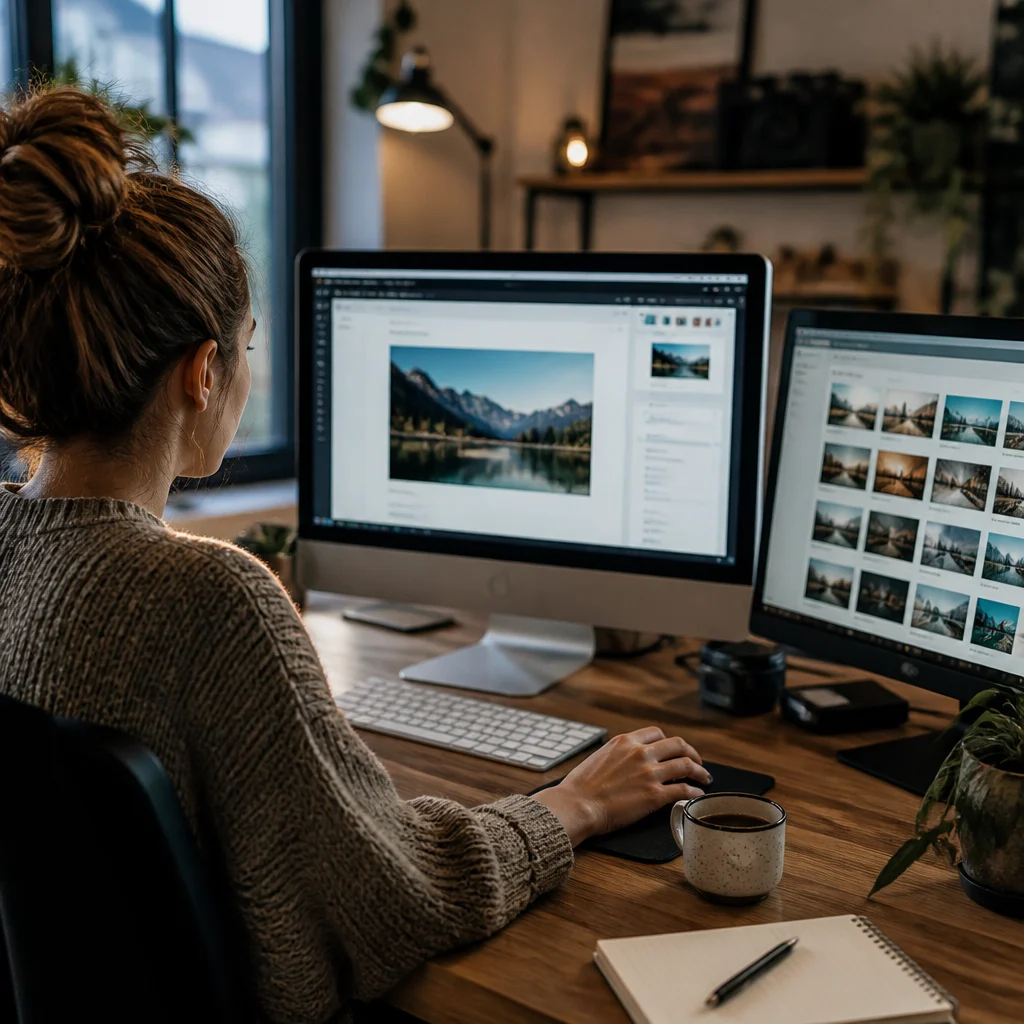
Featured Image Generation in Antradus AI for WordPress
Featured image generation in Antradus AI turns a finished WordPress post into a ready-to-use featured image in one click, including upload, alt text, WebP conversion, and assignment inside your site. The feature is documented at https://antradusai.com/docs/featured-image-generation/, and as of August 2026 it applies to Antradus AI Lite and Pro v2.3.0.
You know the moment: the article is done, the deadline is close, and the empty featured-image box still stares back at you. That last step often takes longer than writing a few paragraphs. Antradus AI cuts that drag out of the workflow by generating an image from the article itself and setting it directly on your WordPress post.
That matters because featured images do real work. They shape click-throughs, frame social previews, and affect how polished your site looks in archives, search results, and category pages. And if you run WordPress at any kind of scale, even a two-minute manual image task repeated 30 times a month becomes a nuisance you can feel.
What is featured image generation in Antradus AI?
Featured image generation in Antradus AI is a WordPress feature that creates a unique article-matched image, adds it to the Media Library, applies descriptive metadata, converts it to WebP, and assigns it as the featured image with one click. Antradus AI is a WordPress AI plugin built to help you create and manage content directly inside your site, and this image tool is part of that workflow rather than a separate design app.
According to the documentation page, the generated file is not left half-finished in a temporary panel. It lands in your Media Library with a proper title, caption, and alt text already attached. That is useful for two practical reasons: SEO and accessibility. You do not have to stop and rename the asset, and you do not have to remember to add alt text after the fact.
The feature is available in Antradus AI Lite and Pro v2.3.0, with the source documentation last updated on 2026-08-05. That date matters because image providers, model support, and shape handling change often. This is not a vague promise of “AI image support.” It is a documented workflow tied to named providers and specific product versions.
There is one important prerequisite. You need an image-capable provider configured with an image model selected. The documentation names three supported paths: OpenAI with gpt-image or DALL·E, Google Gemini with Imagen, and OpenRouter with Flux and compatible models.
It also names two providers that do not currently offer image APIs in this setup: Anthropic and DeepSeek. The guidance is direct. You can still write with Anthropic or DeepSeek in Antradus AI, then switch providers just for image generation.
How does featured image generation work on WordPress?
Featured image generation on WordPress in Antradus AI works by using the article content as the source for the image prompt, then letting you generate, review, and assign the result inside the post interface. The workflow starts only after the article exists, because the system designs the image from the written content rather than from a blank request.
The documented process is short. First, write or generate your article. Next, open the image section in the panel. If you want more control, add art direction in the instructions box. The documentation gives a concrete example: “Warm Mediterranean tones, cinematic lighting, shot from a low angle.” That line tells you exactly how specific the prompt can be. You are not limited to broad style labels.
Then you can choose a style preset for consistency. After that, click generate. The image appears in the panel, and one click sets it as the featured image. From a WordPress operations point of view, that matters because it removes the usual shuffle of downloading a file, reopening the Media Library, uploading it manually, and attaching metadata in separate fields.
The metadata side is worth dwelling on for a second. Antradus AI states that the image is already uploaded with a descriptive title, caption, and alt text. For publishers handling dozens or hundreds of posts, that means fewer half-optimized uploads sitting in the library with filenames like image-7-final-final.png. Small thing. Big difference.
And because the image is converted to lightweight WebP by default, the output is built for ordinary publishing rather than design mockups. If your goal is a fast-loading WordPress site, that default is doing useful work before you touch a setting.
Which providers and models support featured image generation?
Featured image generation in Antradus AI supports OpenAI, Google Gemini, and OpenRouter for image creation, and each provider behaves differently enough that the choice affects shape control, quality settings, speed, and cost. The documentation is unusually clear here, which is exactly what you want before you start generating images in bulk.
OpenAI supports image generation through gpt-image models and DALL·E. It is the only provider in the documentation with an active quality dial. As of August 2026, gpt-image uses Draft, Standard, and Best settings; DALL·E 3 maps to its own standard and HD behavior; DALL·E 2 has no quality setting and only produces square images. The docs also note that non-square images on OpenAI cost slightly more than square ones because the image itself is larger.
Google Gemini is listed with Imagen. Gemini honors image shape exactly, according to the documentation, which makes it a stronger fit when you know your WordPress theme crops featured images into a wide banner. But Gemini does not use the OpenAI-style quality selector here. On Gemini, the way to save money is to choose a cheaper image model rather than lowering a quality tier.
OpenRouter is supported with Flux and compatible models. That support comes with an important caveat: shape is requested in words, so some OpenRouter models obey it and some ignore it. If you choose landscape or portrait, the result can vary by model. That is a real trade-off, not a bug hidden in footnotes.
Anthropic and DeepSeek are explicitly named as non-image providers in this context. The docs say they do not offer image APIs for this workflow. That means they can support writing inside Antradus AI, but they cannot natively perform featured image generation. If you rely on either one for text, you need to switch to OpenAI, Gemini, or OpenRouter for the image step.
| Provider | Named models | Shape handling | Quality setting | Key note |
|---|---|---|---|---|
| OpenAI | gpt-image, DALL·E 3, DALL·E 2 | Exact on supported models | Yes | DALL·E 2 stays square |
| Google Gemini | Imagen | Honored exactly | No active cost dial here | Choose model to affect cost |
| OpenRouter | Flux and compatible models | Requested in words | No active cost dial here | Some models ignore shape |
| Anthropic | Not applicable | Not supported | Not supported | No image API in this workflow |
| DeepSeek | Not applicable | Not supported | Not supported | No image API in this workflow |
Why do Antradus AI presets avoid banners and text?
Antradus AI avoids banner-style prompts and any text inside the generated image because image models follow those instructions too literally and often produce awkward layouts or unreadable lettering. The documentation makes this point with unusual bluntness, and it is one of the most useful parts of the whole page.
The plugin includes ten style presets: Default, Gaming, Medical, News, Sports, Finance, Tech, Food, Travel, and Entertainment. Every preset is fully editable under Antradus AI → 🖼️ Image Generation, which means you can rewrite the visual language once and keep your site consistent across future posts. For a publication with a fixed visual identity, that is practical control, not fluff.
But each preset describes a photograph, never a banner, thumbnail, poster, layout, or template. Why? Because if you ask an image model for a banner, it often composes a central picture and leaves flat empty bars or blocks of color around it. The documentation even warns against wording like decorative shapes or empty space for text, because those prompts can create blank zones, swooshes, curves, or side panels that make a featured image look unfinished in a WordPress theme.
The hard rule is simple: the image should fill the entire frame edge to edge, with no borders, bars, frames, panels, rounded corners, or decorative graphics beside or over it. That rule is more than aesthetic preference. It is a defense against model behavior that clashes with how featured images are displayed on blogs.
The no-text rule is just as strict. The docs state that image models cannot spell reliably, so generated text often turns into visible gibberish burned into the image. Once that happens, you cannot cleanly remove it. So featured image generation in Antradus AI blocks text at generation time: no headlines, captions, badges, scores, logos, tickers, ratings, or watermarks. If you want text, place it in your WordPress theme or page builder where it stays sharp, selectable, and translatable.
What settings matter most for featured image generation?
The settings that matter most for featured image generation in Antradus AI are style preset, color cast, image shape, quality, and output format, because those controls change how the image looks, how long it takes, and what it costs. You do not need to adjust every setting every time, but a few choices have outsized effects.
Start with image shape. The docs list Square (1:1) as the default, Landscape as the best fit for most featured images, and Portrait for phone-first layouts or Pinterest-style uses. Square is the safe default because every model and every theme can handle it. But the documentation says most WordPress themes crop featured images into a wide banner, so Landscape usually fits better. OpenAI and Google Gemini honor shape exactly; OpenRouter asks in words; DALL·E 2 stays square regardless.
Then there is quality and cost. Under Image Quality & Cost, the documented OpenAI timings are concrete: Draft is about 12 seconds per image, Standard about 18 seconds, Best is the sharpest and slowest at several times the price, and Let the AI decide tends to choose the best and most expensive tier at about 33 seconds per image. That last option is a bill-increaser in disguise. The docs even note that sites installed before v2.3.0 may still be set to Let the AI decide after upgrade, so checking that setting can save both money and time immediately.
Format matters too. WebP 82 is the default, described as small files with strong quality. WebP 90 gives larger files with near-perfect quality. WebP lossless increases file size further, and PNG skips WebP conversion entirely. If your generated files save as PNG when you expected WebP, the documentation points to the PHP GD extension as the likely cause and tells you to ask your host about GD.
There is also an optional color overlay under Settings → Image Generation. That color cast tints generated images toward your brand color. It is subtle by design, but on a blog with dozens of posts it can make the archive pages feel more visually consistent.
What can go wrong with featured image generation?
The main things that go wrong with featured image generation are timeout errors, higher-than-expected image costs, shape mismatches on some models, and duplicate media items from repeated retries. None of those issues is hidden in the Antradus AI documentation, which is refreshing.
The clearest example is the documented “504 Gateway Time-out” problem. Antradus AI explains that the timeout comes from your web server, not from the AI provider itself. The image often finished generating anyway, but the request took longer than the host allowed, so the connection was cut before WordPress received the file. That is why the docs tell you to check the Media Library before regenerating and paying twice.
“The image itself is usually generated anyway — check your Media Library before you regenerate and pay twice.”
The recommended fixes are practical and ranked by cost. First, lower Image Quality to Draft or Standard. The docs call that the most common cure, and it also reduces spend. On Gemini and OpenRouter, where no equivalent quality dial is active, the fix is choosing a faster image model instead. If the hosting layer is the bottleneck, the docs name specific server settings: fastcgi_read_timeout or proxy_read_timeout raised to 300 seconds. They also warn that Cloudflare caps requests at 100 seconds on Free and Pro plans as of the documented guidance.
There are softer trade-offs too. Generate again and you get a new Media Library item every time, so rejects must be deleted manually. Album-style needs are a separate feature entirely; the page says multiple in-article images belong to Album Generation, not featured image generation. And if you edit presets carelessly, using words like banner or empty space, you can reintroduce the exact visual problems the defaults were built to avoid.
What should you do next?
The next move is simple: use featured image generation in Antradus AI after the article is finished, switch your shape to Landscape if your WordPress theme displays wide featured banners, and check whether your provider setup actually supports image creation. That turns the feature from a nice idea into a reliable publishing habit.
If you write with Anthropic or DeepSeek, keep doing that for text, then switch to OpenAI, Google Gemini, or OpenRouter for the image step. If your bills or wait times feel too high, look at Image Quality first on OpenAI and at the model choice first on Gemini or OpenRouter. If you hit a 504, check the Media Library before clicking generate again.
And if brand consistency matters, edit the presets once instead of rewriting style guidance post by post. That is where Antradus AI earns its keep on WordPress: fewer repeated tasks, fewer avoidable formatting mistakes, and a cleaner path from draft to published post. The full documentation is here: https://antradusai.com/docs/featured-image-generation/.