
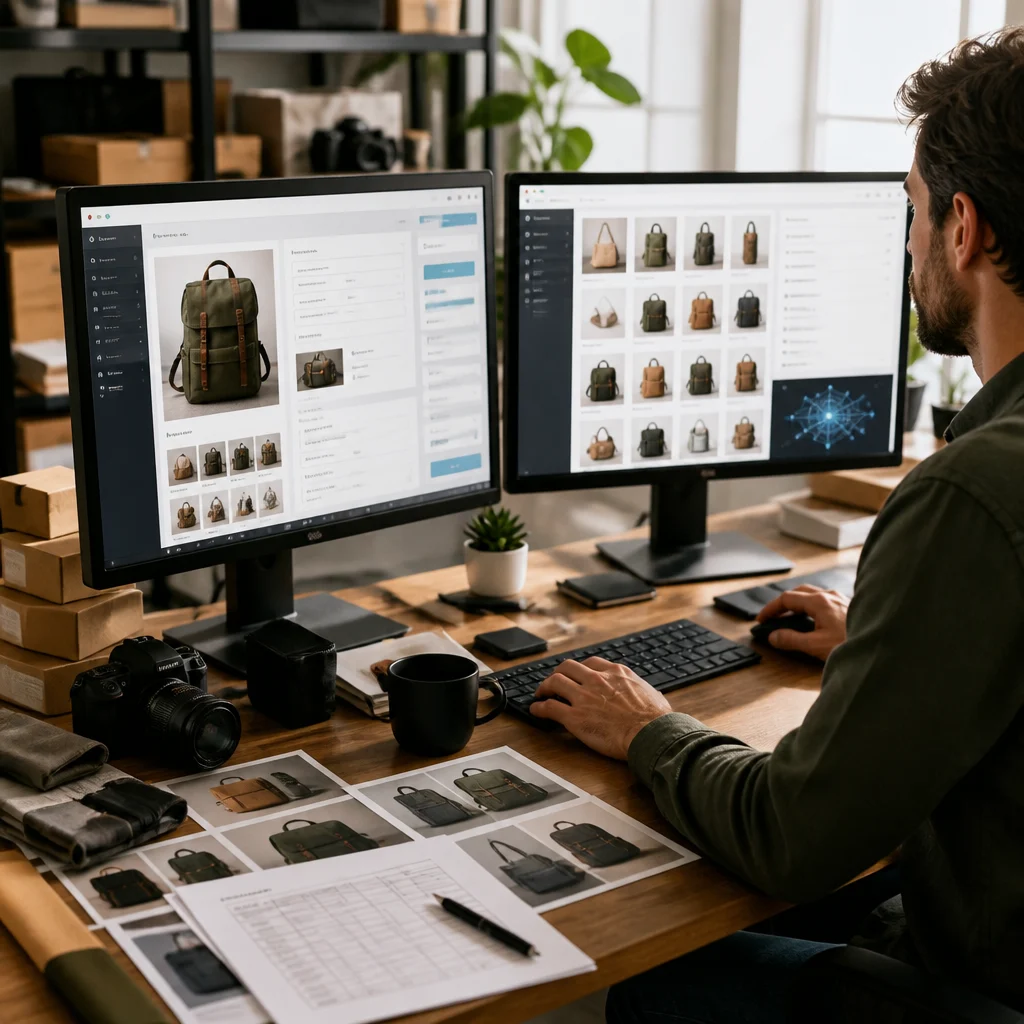
Product Photo AI for WooCommerce: How Antradus AI Builds Listings From Images
Product photo AI turns a folder of images and a simple price list into draft WooCommerce products in minutes, using Antradus AI on WordPress to write names, descriptions, short descriptions, and SEO from each image. The documented workflow at https://antradusai.com/docs/recipe-woocommerce-store-from-photos/ is built for fast catalog creation as of 2026.
Picture the usual catalog job: dozens of photos, a spreadsheet with prices, and a product editor waiting for copy you still have to write. That is where Antradus AI tries to remove the slowest step. Instead of drafting every listing from scratch, you feed the product image to the AI, add the facts the camera cannot see, and let the plugin produce the core store content inside WooCommerce.
Antradus AI is a WordPress plugin designed to generate and assist with content directly inside your site’s workflow. In this specific documentation recipe, it works with WooCommerce and a vision-capable AI provider so you can stock a store from product photos rather than from a blank text field.
What is product photo AI doing inside WooCommerce?
Product photo AI in WooCommerce means the AI looks at a product image, combines that visual input with facts you type manually, and then fills product fields for you inside the editor. According to the Antradus AI documentation, the output includes the product name, long description, short description, and SEO meta content.
The workflow applies to Antradus AI Pro v2.0.0, with the documentation page marked last updated 2026-07-24. That date matters because plugin features move fast, and store owners need to know whether a recipe reflects the current interface. Here, the process is documented as part of Antradus AI’s WordPress workflow, not as a generic theory piece.
The store setup is practical. You start with one good primary image per product, then add the facts that a photo cannot reveal. The source specifically names brand, sizes, materials, and price as examples of those invisible facts. That gives the model enough structure to write product copy that sounds grounded instead of speculative.
Why does that matter right now? Because uploading products is rarely blocked by photography alone. The delay usually comes from writing 30, 50, or 200 descriptions that still need to sound distinct, include key facts, and fit your store’s tone. Product photo AI does not replace review, but it cuts the first draft stage sharply.
How do you use product photo AI with Antradus AI?
To use product photo AI with Antradus AI, you create a WooCommerce product, set the main product image, add short factual notes in the plugin panel, and trigger the image-based writing action. The documented process is direct and built for repetition.
The source page lays the steps out per product, and it estimates about 2 minutes each. You go to Products → Add New in WooCommerce. Then you set the Product image in the right-hand panel. That image is the one the AI examines, so the primary shot matters more than a gallery image buried later in the listing.
Next comes the instruction that makes the whole system work: in the Antradus AI panel text box, you type the non-visible facts in a short, compressed format. The documentation’s example is specific: “Brand: Acme. Sizes S-XL. 100% organic cotton. Includes carry pouch.” That short input tells you something important about the design. You are not being asked to write full copy. You are feeding the model the facts it cannot infer from pixels alone.
After that, you click the action labeled “📷 Look at my product photo & write everything”. Antradus AI then examines the photo and fills the product name, long description, short description, and SEO meta fields. You finish by setting price and inventory, reviewing the copy, and hitting Publish.
So the real promise is speed with structure. WooCommerce stays the publishing system. Antradus AI, running on WordPress, handles the drafting layer inside that familiar editor.
Which AI providers work for this product photo AI workflow?
The product photo AI workflow in this Antradus AI recipe requires a vision-capable provider, and the documentation names OpenAI, Claude, and Gemini as supported examples while explicitly excluding DeepSeek. That distinction matters because not every language model can reliably inspect an image.
The source is unusually clear here. It does not say “any provider” or “most AI tools.” It says you need a vision-capable provider, specifically naming OpenAI, Claude, or Gemini, and then adds not DeepSeek. For a store owner, that removes guesswork before setup even starts.
OpenAI gets substantive coverage in the recipe because it is one of the providers Antradus AI can use for image-aware product generation in WooCommerce. In this workflow, OpenAI’s role is not generic text generation; it is visual interpretation plus copy drafting based on the product photo and your typed facts.
Claude is also named as a valid vision-capable option for the same task. Within the documented recipe, Claude serves the same operational purpose: it can inspect the product image and help generate store-ready text fields. The page does not rank Claude against OpenAI or Gemini, so an honest reading stops there.
Gemini appears as the third supported provider. Again, the documentation ties Gemini to image-based writing inside the WooCommerce flow, not to a separate export or external app. If your WordPress setup already uses Gemini through Antradus AI, the same recipe applies.
DeepSeek, by contrast, is directly ruled out for this recipe. The documentation says not DeepSeek, which means DeepSeek does not currently fit this documented product photo AI workflow. That is an important limitation, and it deserves to be said plainly rather than buried.
What batch process makes product photo AI fast enough for a real catalog?
The fastest batch process for product photo AI is to prepare all images first, keep a facts file open, and repeat the same five-step rhythm for each item. Antradus AI’s own documentation describes this as the pattern that works in practice.
The key operational advice is simple: upload all photos to the WordPress Media Library first by drag-and-dropping the folder. That removes a repeated upload step from every individual product. Once the images are in place, product creation turns into a cleaner sequence: pick image → paste facts → click → price → publish.
That rhythm matters more than it looks. Catalog work slows down when you switch contexts every minute, hunting for files, renaming things, and retyping the same size or material details. By keeping a facts file open beside the product editor, you can copy and paste one product line at a time. The source explicitly recommends that setup.
Antradus AI also gives a concrete scale estimate: 30 products ≈ an afternoon, including review. That is not a promise of fully hands-off publishing. Review is built into the estimate. And that is the right expectation to set. Product photo AI speeds drafting, but the last pass still belongs to the merchant or store manager.
For small teams, this is where the workflow becomes useful instead of merely interesting. Say you run a three-person shop on WordPress and need to launch a seasonal collection quickly. You do not need a giant PIM system to benefit. You need one strong hero photo per product, a prepared facts list, and a repeatable routine inside WooCommerce.
Where does product photo AI go wrong?
Product photo AI goes wrong when the image is weak or when you expect the model to know facts that are not visible in the photo. The Antradus AI documentation is candid about both failure points, and that honesty makes the recipe more trustworthy.
The first limit is image quality. The source says the better the photo, the better the copy. It specifically recommends a clean background and one product per shot. That guidance is not cosmetic. If the image is cluttered, cropped oddly, or shows several items at once, the AI has less chance of describing the right object clearly.
The second limit is missing factual input. The page warns that you should always add the brand and sizes in the text box. Why those two? Because they are exactly the kind of details a model can state confidently while being wrong if you leave it guessing. A shirt photo does not reliably tell the AI whether the product comes in S-XL, or whether the brand is your private label or a wholesaler’s line.
There is also a cost-visibility note that deserves attention. The documentation says the Reporting page counts vision calls in your token totals, so catalog costs stay visible. That does not give a public price figure in the source, but it does tell you where usage is tracked inside the system. If you are processing dozens of products, that reporting view is part of the workflow, not an afterthought.
Antradus AI documentation: “The better the photo, the better the copy — clean background, one product per shot.”
That single line captures the trade-off. You save time on writing, but only if you keep the inputs disciplined.
What should you actually do next with product photo AI?
The right next step with product photo AI is to test the workflow on 5 to 10 products before you commit a full catalog. That small batch will tell you whether your photos, facts file, and provider choice are strong enough for smooth WooCommerce publishing.
| Workflow element | What the documentation requires | Why it matters |
|---|---|---|
| Antradus AI version | Antradus AI Pro v2.0.0 | The recipe is documented for this version as of 2026-07-24 |
| Platform | WordPress with WooCommerce | The process runs inside the product editor |
| Image input | One good primary shot per product | The AI reads the main product image |
| Text input | Brand, sizes, materials, price, other invisible facts | Prevents wrong assumptions |
| Supported providers | OpenAI, Claude, Gemini | They are named as vision-capable options |
| Unsupported provider | DeepSeek | The recipe explicitly says not to use it here |
| Estimated pace | About 2 minutes per product | Sets realistic expectations for manual review |
Start by reading the original Antradus AI documentation page at https://antradusai.com/docs/recipe-woocommerce-store-from-photos/. Then prepare a folder of clean product photos, open your facts sheet, and build a short pilot run inside WooCommerce.
If the first batch comes out accurate, you have a repeatable WordPress process. If it does not, the fix is usually obvious: better photos, clearer brand and size data, or a tighter review step before publishing. That is a practical place to be.