
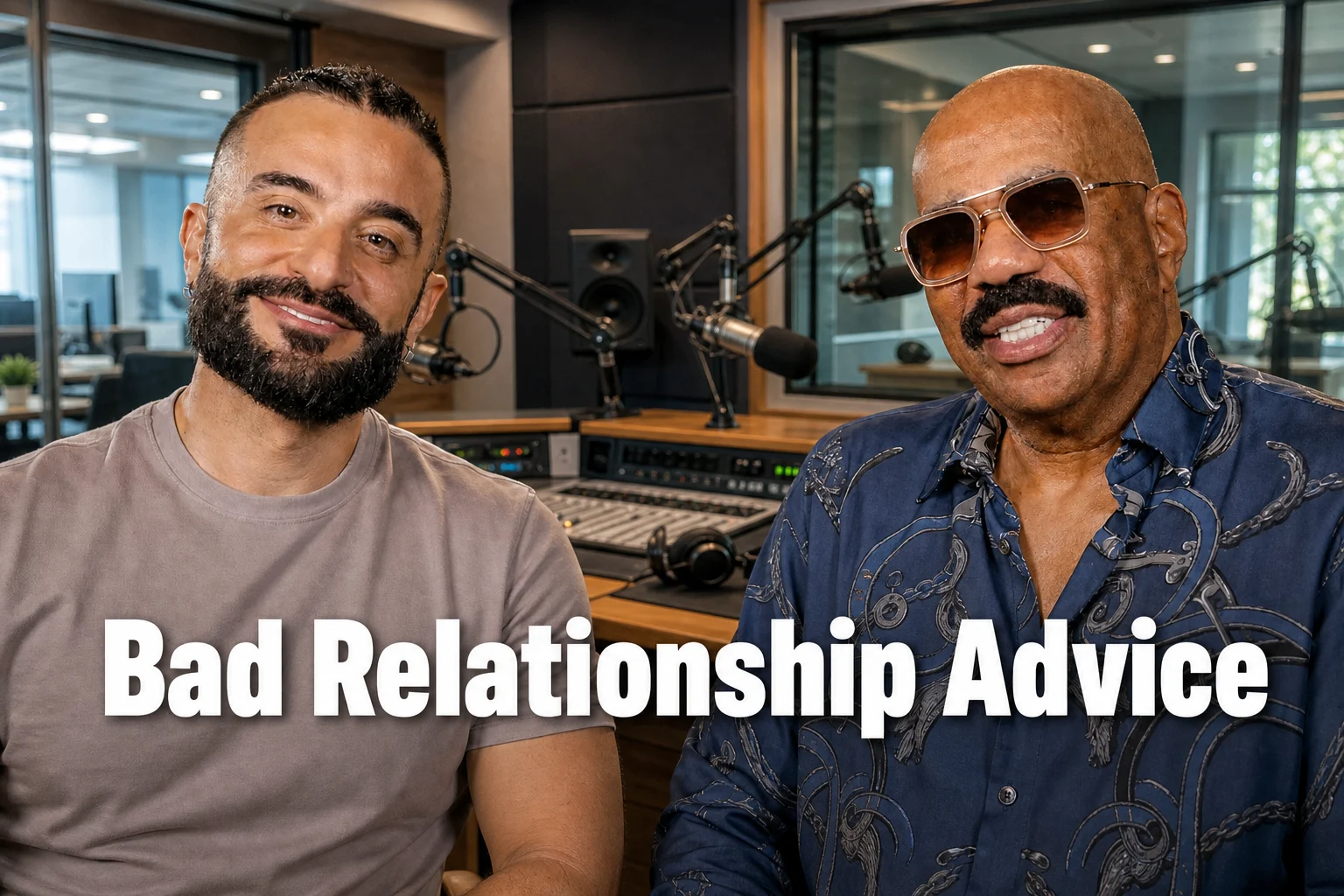
Steve Harvey’s blunt advice on bad relationships and men’s bad decisions
This article draws on our conversation with Steve Harvey.
Steve Harvey says bad relationship advice starts with ignoring what you already know, and his answer is simple: when a woman feels something is wrong, she should leave. He ties men’s bad decisions to immaturity, desire, and years of learning the hard way inside marriage, divorce, and regret.
He puts one concrete explanation on the table fast. Steve Harvey says men have 2 body parts that think for them, and he says 100% of the problem is that an upper part and a lower part both try to run decisions, with the lower part choosing on looks alone (41:08).
Why does Steve Harvey say women should trust their intuition in bad relationships?
Steve Harvey says women should trust their intuition in bad relationships because he believes they are given an inner warning system that men do not have in the same way. He frames that instinct as something you do not explain away, bargain with, or wait to have proven after the damage is done.
That matters to his whole view of bad relationships. He is not telling women to stay in place while a man sorts himself out. He says that if your spirit is telling you something is off, you should go. In his telling, that signal arrives before the facts are neat, before the confession, before the obvious ending. And he treats ignoring it as one of the costliest mistakes people make.
He keeps the point inside a moral frame. Harvey does not describe every man as trying to be cruel, unkind, abusive, or to use people. He says a man can come through that immature phase by the grace of God if he is not set on doing harm. But that qualification does not cancel the warning to women. It sharpens it. A man does not have to wake up intending to wreck your life for his confusion, vanity, and appetite to do real damage anyway.
So his advice on relationship intuition is not a theory about how all people think. It is a practical rule about what you do next. If your read on a man keeps coming back wrong, he does not ask you to keep collecting evidence. He says leave.
Why do men make such bad relationship decisions when they are young?
Steve Harvey says young men make bad relationship decisions because attraction and immaturity pull them harder than judgment does, and he says most of them do not get those impulses working together until they are older. His explanation is rough on purpose, because he is describing what he sees as a pattern of damage before maturity catches up.
“Pray that you get old before you kill yourself.”
— Steve Harvey (42:04)
That is where he lands the warning. He says young men make stupid choices first and understand them later. In his account, the lower drive picks on looks, the higher mind arrives late, and the syncing up happens after enough mistakes have already been made. You can hear the hindsight in that argument. He is not describing polished wisdom at the start of adult life. He is describing survival through bad relationships, bad judgment, and consequences that felt obvious only after the fact.
He ties that directly to age. Older men, in his view, are not magically different men. They are men who have finally lived long enough to see where reckless desire leads. That is why his phrasing is so severe. He is saying youth is dangerous partly because confidence shows up before discipline does.
And he does not dress it up with flattering language about growth. He says destructive choices often happen before the lesson arrives. That is his plain answer to why men’s bad decisions in romance can look so senseless from the outside: they often are senseless while they are happening.
How does Steve Harvey connect bad relationships to his own life and to raising his son?
Steve Harvey connects bad relationships to his own life by speaking from hindsight, especially around marriage and divorce, and by measuring growth through how a man learns to treat women. He turns the subject away from abstract debate and back to conduct: what you do, what you ignore, and what you teach your son before he repeats your mistakes.
That is where his comments about maturity stop sounding like a joke and start sounding personal. He links the mess young men make to the life they later have to explain to themselves. Marriage and divorce sit in the background of what he says as proof that decisions made in immaturity do not stay in youth. They carry forward. They shape homes, endings, children, and memory.
He also gives one clear standard for what learning should look like. He says he tried to raise his son to be a gentleman who treats women with kindness and respect. That is not a side note. It is his answer to the damage he spent the rest of the discussion describing. If young men are impulsive and late to wisdom, then somebody has to teach them what restraint and decency look like before pain does it for them.
So the article’s subject is not whether men and women are identical in how they read danger. Harvey is making a narrower claim. People ignore warnings, men often learn late, and the price can be a marriage, a family, or years wasted in bad relationships before maturity finally arrives.
Listen to the full episode
Listen to the full conversation on Spotify — the episode goes further than any article can, and following the show means you catch the next one.
 Watch this episode on YouTube ·
  Listen on Spotify · Subscribe to One On One with Kris Fade
Links from this episode
Mentioned in the episode. Some of these may be affiliate or sponsored links.
This content was created with the help of AI (Antradus AI - gpt-5.4).