
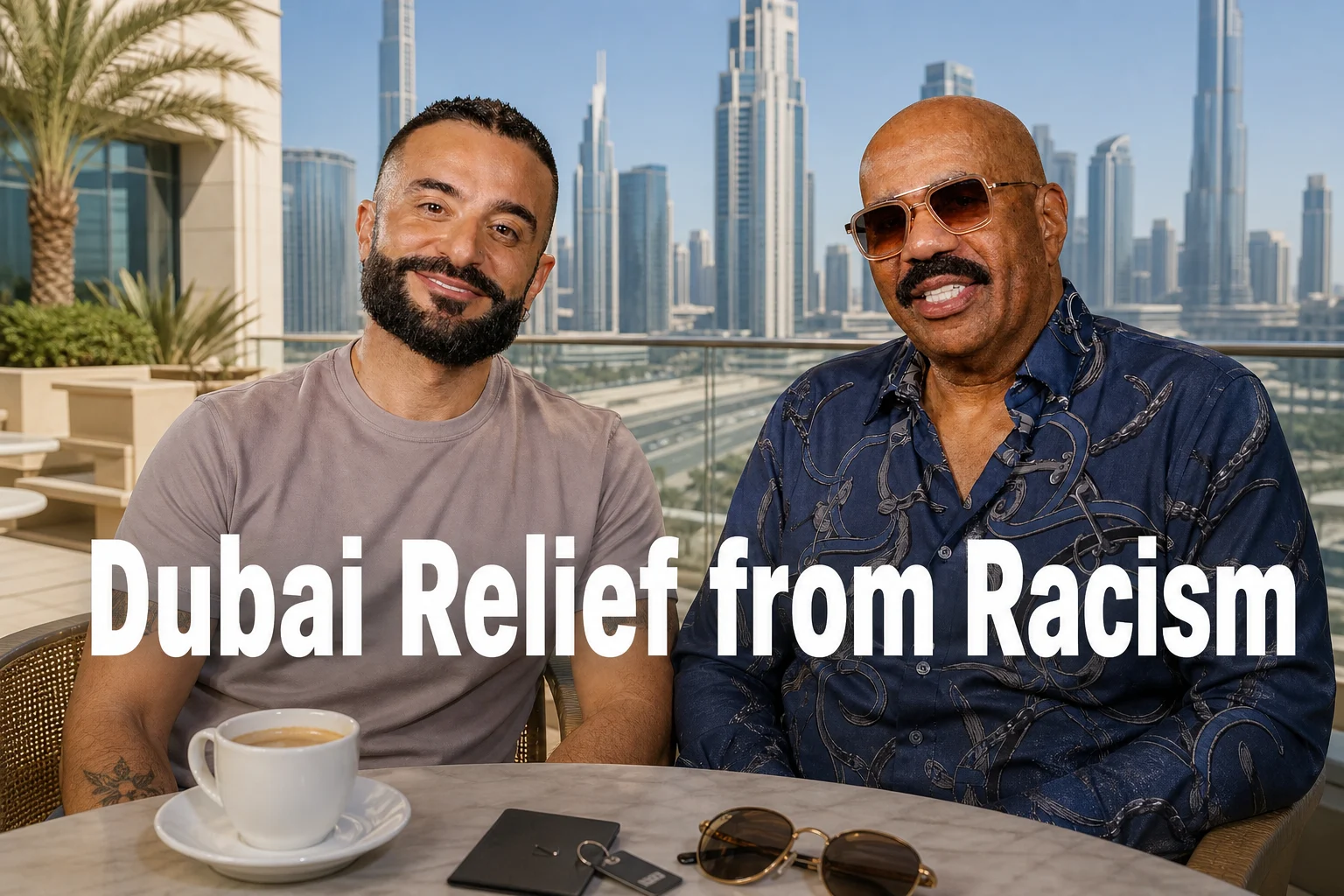
Why Steve Harvey says Dubai feels like relief from racism
This article draws on our conversation with Steve Harvey.
Steve Harvey says the relief he feels in Dubai has nothing to do with pretending racism does not exist and everything to do with not carrying it into every room. He says that, for him, working there means race does not sit in front of the job the way it has throughout his life in the United States.
Dubai is the place he names, and Kris Fade adds his own reason for why that matters. Kris says he felt boxed in by ethnic stereotypes in Australia before moving to Dubai, where he found a different kind of social mix and a different kind of freedom.
Why does Steve Harvey say Dubai feels like relief?
Steve Harvey says Dubai feels like relief because he does not have to factor race into simply doing the work there. He sets that against a lifetime in America where being Black was never something he could put down, even for a day, and where racism was never an abstract issue to him.
“I’ve been black the whole time.”
— Steve Harvey (1:01:35)
That line is how he explains the contrast. He is not describing a theory or a political slogan. He is describing a constant condition, something he says has followed him through every part of his life in the United States, without breaks and without anybody needing to explain to him what racism looks like.
Placed next to that, Dubai becomes meaningful to him because it feels less loaded at the point of entry. The work can stay about the work. The room does not ask him to process the same racial calculation first. That is the relief he is talking about.
He also ties that feeling to the social makeup of the city and the wider UAE. Steve Harvey says Dubai or the UAE has 160 nationalities living there (59:36), and he describes people living in harmony while respecting one another’s cultures and religions. His point is practical: where many different groups live side by side, daily life has to make room for difference instead of turning difference into a fight before anything else can happen.
So when he talks about relief, he is not saying prejudice has vanished from human beings. He is saying Dubai feels different to him because ordinary life there does not force race to the front in the same way.
What does Steve Harvey mean when he says a bigot would struggle in Dubai?
Steve Harvey means that prejudice becomes harder to organize in a place built from many national backgrounds. He explains the idea with a blunt joke that also doubles as a social observation about the UAE.
“If you come to Dubai, if you come to the UAE and you a bigot, you’re in trouble, because you got to hate everybody.”
— Steve Harvey (59:23)
The point underneath the line is simple. A person looking for one group to isolate runs into a city where difference is normal, visible, and everywhere. The target keeps moving because the population is not built around one narrow identity. Harvey’s description of Dubai rests on proximity: many peoples, many cultures, many religions, all in the same daily space.
The number attached to that picture appears again in a second form when he says there are 160 nationalities living in Dubai (1:01:11). He uses that detail to support the broader claim that coexistence there is not a slogan but a lived arrangement. People are not asked to erase where they come from. They are expected to respect where other people come from too.
Kris Fade’s account sits naturally beside that. Kris says that as a Lebanese-Australian, he felt stereotyped in Australia, where Arabs, especially Lebanese people, were often seen as gangsters and drug dealers. He says he felt blocked in media because of his ethnicity until he moved to Dubai. In his telling, Dubai did not remove identity from the equation; it changed the equation by placing him in a society where mixed backgrounds were ordinary rather than suspect.
That is why the Dubai Harvey describes is not a fantasy of sameness. It is almost the opposite. The relief comes from being in a place where many identities are already in the room.
Why does Steve Harvey say America is moving backward on race?
Steve Harvey says America is moving backward because open racism now feels less hidden to him and more confident. He connects that warning to his own long experience of race in the United States and to the way others around him have also felt marked before they Cedric the Entertainer a word.
“It’s hard to be from there.”
— Steve Harvey (58:41)
That line fits the American side of the comparison because the subject is not one bad moment but the weight of a wider setting. Kris Fade gives one example from his own life: about four years ago, at the Statue of Liberty, a guard or policeman told him you want to check that beard in (1:00:37). He took the remark as racist, and he uses it to show how quickly appearance and ethnicity can trigger suspicion.
His earlier account of Australia carries the same pattern. He says he was read through a stereotype before he was read as a broadcaster or a person. Harvey’s account of the United States works in that same direction, only from the position of a Black man saying there was never any pause from racial reality. For both men, the problem starts before the individual gets to define himself.
Harvey ends this part of the discussion with a warning, not a fix. He says America is taking backward steps and that white supremacists are more brazen and more empowered now. Against that backdrop, Dubai stands in his account as a place where he can breathe differently, and where race does not have to announce itself before everything else does.
Listen to the full episode
Listen to the full conversation on Spotify — the episode goes further than any article can, and following the show means you catch the next one.
 Watch this episode on YouTube ·
  Listen on Spotify · Subscribe to One On One with Kris Fade
Links from this episode
Mentioned in the episode. Some of these may be affiliate or sponsored links.
This content was created with the help of AI (Antradus AI - gpt-5.4).