
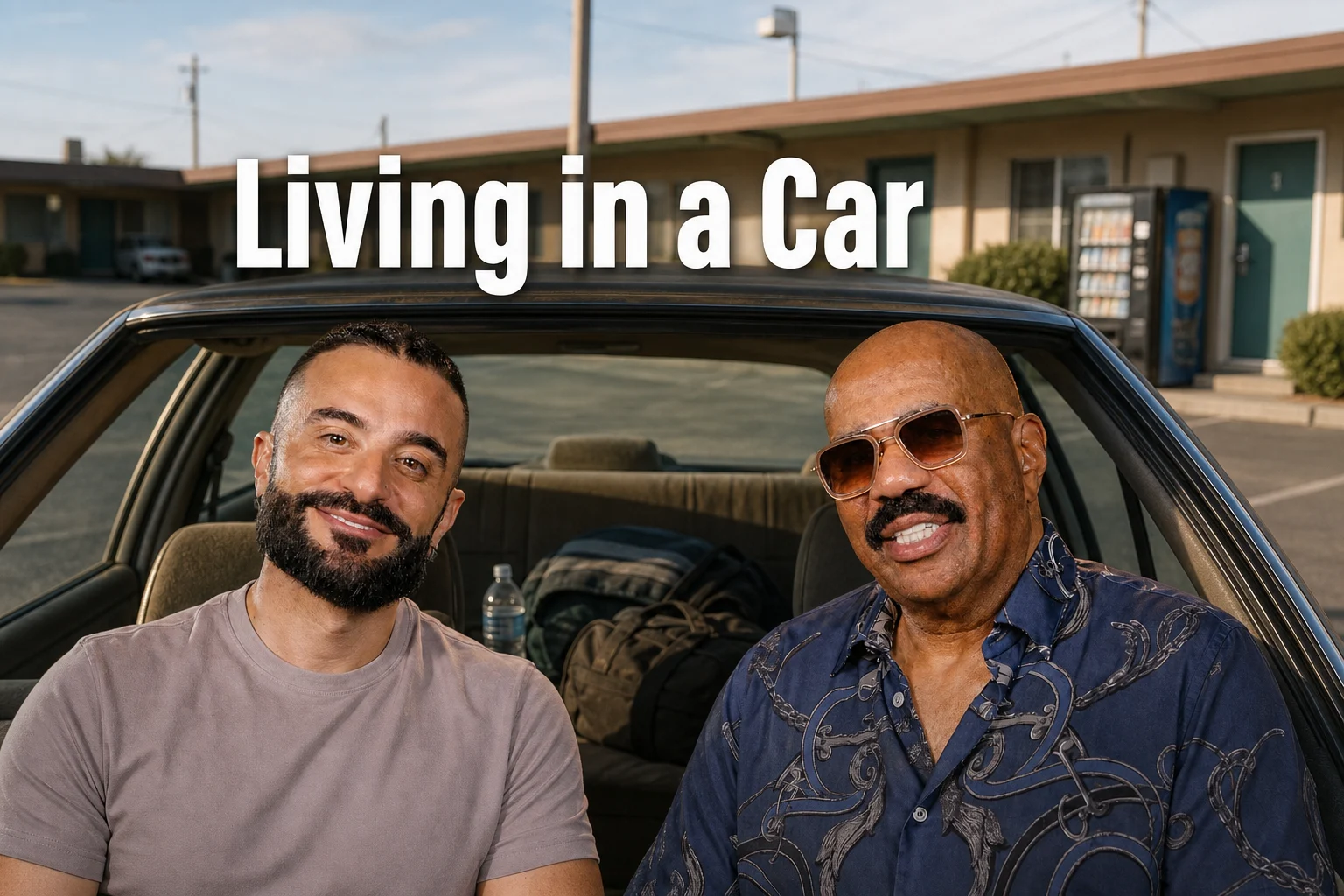
What Steve Harvey learned from living in a car for three years
This article draws on our conversation with Steve Harvey.
Steve Harvey says the hardest lesson from his years of car living was not toughness but misjudgment: he put himself in a marriage he should not have entered, spent years in a place that never felt like home, and only later understood that he was not ready to be anybody’s husband.
He ties that understanding to one brutally plain detail. He says he lived in a car for three years (35:28), and he keeps the story fixed on what was missing, not on any polished comeback version of it.
What did Steve Harvey actually learn from car living?
Steve Harvey says car living taught him that survival and stability are not the same thing. He does not describe a vehicle as some rough but workable substitute for a house. He says the opposite. A car, in his account, strips life down to what you can endure because it has none of the ordinary pieces that let a person exhale: no TV, no bathroom, no living room, no place that feels settled.
That matters because he connects the physical setup to the emotional pressure it created. If you are reduced to that little space, your decisions stop coming from calm. They come from discomfort, fatigue, and the wish to get out of the situation fast. Harvey does not frame those years as a romance with struggle. He frames them as unstable and exposed.
“Do what it’s like at night, to not be able to say I’m going home?”
— Steve Harvey (37:50)
That question carries the whole point. A person without a home is not missing square footage in the abstract. A person without a home is missing the sentence people say every day without thinking. In Harvey’s account, that missing sentence changes how you move, how you rest, and what kind of decisions start to look reasonable when they are not.
So the lesson was not simply keep going. The lesson was that a stripped-down life can push you toward choices made for relief instead of wisdom, and he treats that as part of the cost.
How did living in a car shape his marriage decisions?
Steve Harvey says car living pushed him toward a relationship decision he later judged harshly: he moved in with a woman, they wound up getting married, and he blames himself for it. He does not spread the blame around. He says it was a bad decision, and he links that decision directly to where he was in life.
The connection is practical before it is philosophical. If you are sleeping in a car, the offer of a roof is not a small thing. A roof can start to feel like rescue. But Harvey’s account does not treat rescue and compatibility as the same thing. He speaks as someone who learned that they are not.
He also does not flatten that marriage into a single note. He says his youngest son from that marriage made the whole thing worth something. That keeps the story from becoming neat, because he does not erase what came from the mistake even while naming the mistake plainly.
From there he broadens the point into how he sees divorce. He says he does not recommend divorce to anybody because it is ugly. But he also says that if two people made a mistake and should not be married, they have to admit it. That is as close as he gets to a rule: do not glorify the breaking apart, but do not lie about a bad fit either.
What you hear in that view is not theory. You hear somebody tracing a line from unstable housing to unstable judgment, then refusing to pretend the outcome was noble just because he survived it.
Why did he sit outside the house for two hours?
Steve Harvey says he would sit outside for two hours in the car before going into the house because he expected hell once he opened the door (39:49). That detail answers the emotional side of the story more clearly than any general statement could.
A lot of people hear a success story and jump straight to resilience. Harvey stays with dread. He describes driving up to the house and not wanting to walk in. Not because he was tired. Because he already knew what waited on the other side of the door.
That turns the story from simple hardship into a picture of daily resistance. The car was not home. The house was not peace. He had created a life where neither place offered rest, and that is the condition he finally judges with the most force. He says that at that stage of his life, he should not have been anybody’s husband.
“Game changer, man, game changer.”
— Steve Harvey (40:30)
He uses that line for what happened later with Marjorie. In his telling, the change is not cosmetic. Meeting Marjorie marks the point where he sees the earlier version of himself for what it was: a man trying to build marriage on a foundation that was not ready for it. He leaves the listener with a hard, narrow conclusion. The problem was not only where he was sleeping. The problem was who he was at that time, and he says he knows that now.
Listen to the full episode
Listen to the full conversation on Spotify — the episode goes further than any article can, and following the show means you catch the next one.
 Watch this episode on YouTube ·
  Listen on Spotify · Subscribe to One On One with Kris Fade
Links from this episode
Mentioned in the episode. Some of these may be affiliate or sponsored links.
This content was created with the help of AI (Antradus AI - gpt-5.4).