
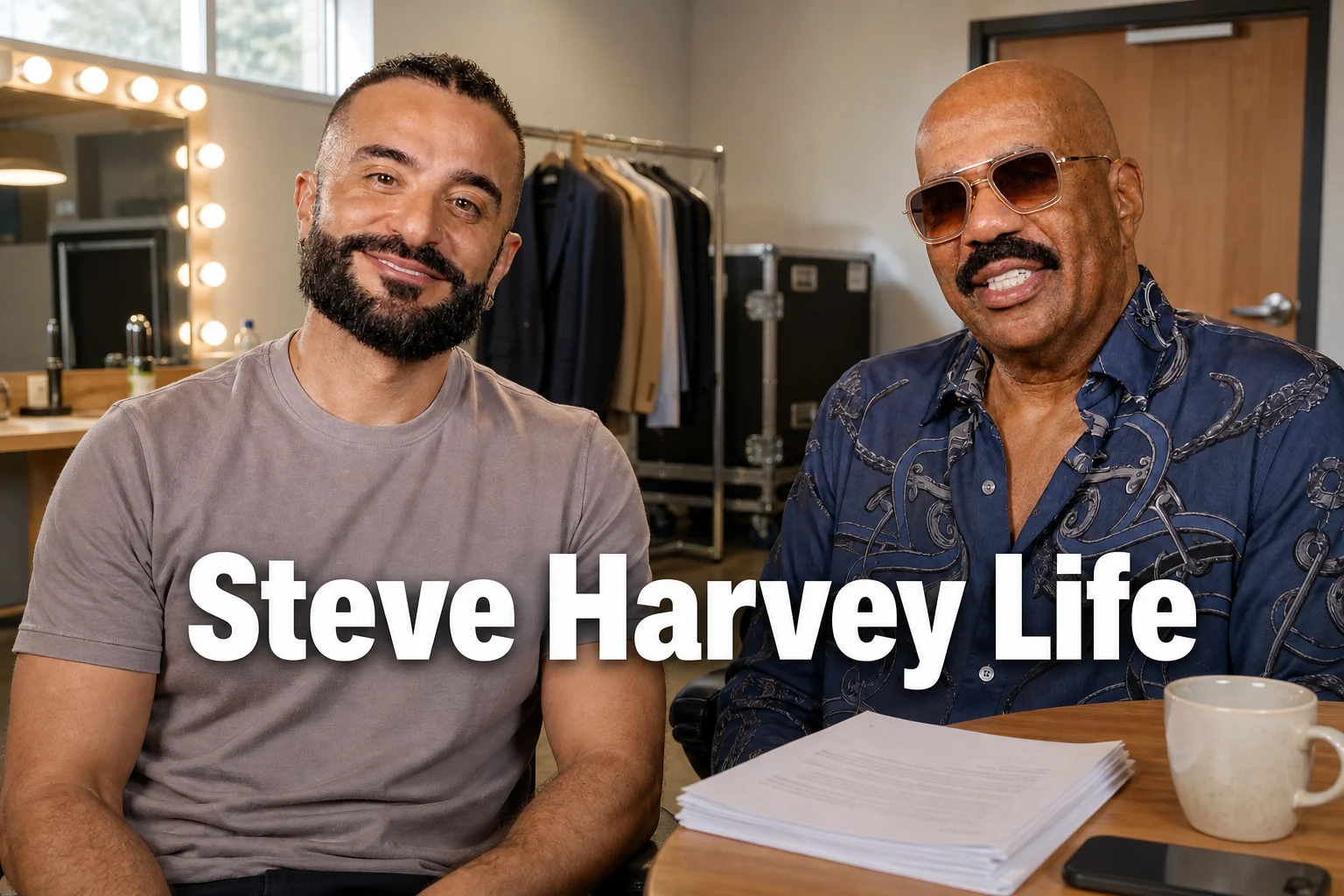
Steve Harvey on homelessness, fatherhood, work and why he stays out of Hollywood
This article draws on our conversation with Steve Harvey.
Steve Harvey ties his life together with a few hard rules: protect your family, keep working with purpose, learn from the years that broke you, and don’t let Hollywood or America tell you they’re the center of everything.
He starts from specifics, not slogans. America has reach and polish, he says, but it also has a television market of 354 million, and that scale helps explain why American versions of global formats look bigger than the originals (2:44).
Why does Steve Harvey stay out of Hollywood?
He says he avoids Hollywood because he does not think its social world helps him live the life he wants, and because the industry gets too much credit for originality in the first place. Harvey points to American Idol, X Factor, and America’s Got Talent as formats created outside the US, with America excelling more at size and finish than invention.
He also says technology has weakened Hollywood’s old gatekeeping power. That matters to how he works and where he works. Family Feud is shot in Atlanta, not Los Angeles, and he treats that as part of a larger decision to keep some distance from the machinery and habits people associate with celebrity culture.
“That line going to get blurred.”
— Steve Harvey (8:46)
He says that while talking about media and social platforms, where attention can flatten the difference between what matters and what merely travels fast. The same thinking sits behind his distrust of online performance. He calls social media the devil’s playground because people will trade truth for clicks, and he talks about that as one more reason to step away from scenes that reward visibility over judgment.
So he leaves early. He says bad stuff usually happens after one AM, and he structures his life around not being there when the room changes. Harvey’s choice to stay out of Hollywood is less about hating the business than refusing the culture around it.
How did fatherhood change him?
He says fatherhood changed him by forcing him to admit where he failed his sons and where he became fiercely protective of his daughters. Harvey describes one of his main mistakes as treating his boys like a unit instead of seeing them as separate people with different needs, temperaments, and pressures.
With his daughters, he talks in much more protective terms. One daughter is 16 (8:16), and he also speaks about daughters aged 16 and 14 when he explains the rules he lives by around the boys and men who enter their orbit. In his account, a boy can leave, a boy can stop texting, a boy can disappear if he wants. What he cannot do is put his hands on them.
That protectiveness opens into a broader idea about a man’s place inside a family. Harvey says men like him cannot put themselves ahead of their wives and children. He frames happiness less as private pleasure than as provision and relief: doing what needs to be done, then watching the people you love feel safe and happy because of it.
The line between old-school discipline and individual attention runs through everything he says here. He does not present himself as a father who got it all right. He presents himself as one who learned late that love is not always enough if you are applying the same method to every child in the house.
What keeps Steve Harvey working after 40 years?
He says purpose keeps him working, not the chase for more money. After 40 years in the business (36:08), Harvey describes himself as being in a calling phase instead of a career phase, which shifts the reason for work from advancement to usefulness.
That idea shows up most clearly in the mentoring camp he runs for boys from fatherless homes. He tells a story about a boy who came to the camp about four years ago (24:35). At the camp, the boy met a Delta pilot, and that meeting gave him a path he had not seen for himself before. Harvey says the boy went back home, started making straight A’s, and changed the direction of his life.
Then came the part he clearly holds onto. Three years later, the same boy returned as the keynote speaker after flying a plane in himself (26:12). Harvey uses the story to explain what he means by calling. He is not talking about staying busy. He is talking about putting a child in front of one new example and watching a whole future rearrange itself.
“Son, the best thing you can do for poor people is not be one of them.”
— Steve Harvey (26:58)
He uses that line while talking about responsibility and aspiration, not distance from people who are struggling. In the way he tells it, earning, building, and providing are duties. Money by itself is not the purpose. What matters is what disciplined work lets you do for the people who depend on you.
What did homelessness and marriage teach him?
He says hardship taught him that desire alone does not qualify you to lead a family, and that some seasons of a man’s life make him unfit for marriage. Harvey speaks plainly about living in a car for three years and about the emotional wear that came with it.
“Do you know what it’s like at night, to not be able to say I’m going home?”
— Steve Harvey (37:50)
He pairs that with another image that is even more intimate: sitting outside a house for two hours because he did not want to go inside (39:49). The point is not dramatic scenery. The point is inner condition. By his own account, he reached a conclusion from that period that he should not have been anybody’s husband then.
He also links growth to age instead of pretending wisdom arrives on time.
“Pray that you get old before you kill yourself.”
— Steve Harvey (42:04)
That line sits inside his account of men making bad decisions, wrecking relationships, and confusing impulse with adulthood. He talks about marriage with the hindsight of someone who knows his earlier self brought damage into rooms he was not ready for.
Marjorie enters the story as the turning point. He credits meeting her with changing the direction of his personal life, which fits the larger pattern of the conversation: the right person can matter, but only if you have become capable of meeting that person differently than you met the last one.
What does Steve Harvey say makes him happy now?
He says happiness now comes from service, routine, faith, and the sight of people close to him doing well because he did his job. Harvey does not talk about happiness as excitement or status. He talks about it as alignment between duty and affection.
His mother sits inside that frame. He says she was a Sunday school teacher for 40 years (31:00), and that long example of steady service helps explain why he describes his own life less in terms of fame than assignment. You can hear the inheritance in the way he separates career from calling.
“It’s the best cake on planet Earth.”
— Steve Harvey (21:12)
The line comes during a lighter moment, but it still fits the larger picture because his version of happiness is concrete. Food. Home. People you know. Time away from noise. Nothing in the way he describes contentment sounds like a red carpet after midnight.
He says men in his position cannot put themselves before their wives and kids, and he returns again to the satisfaction of providing. That is how he defines peace now. Not applause. Not access. Making sure the people attached to your name are secure, then enjoying ordinary life with them.
Why does Dubai feel different to him?
He says Dubai feels different because he is not forced to calculate race in every encounter the way he feels he must in the United States. Harvey describes that as relief, not novelty, and he ties the feeling to daily life rather than to a tourist impression.
He praises a place where 160 nationalities live together (59:36). For him, that number represents a social reality you can feel in the street, the hotel, the restaurant, the workplace. People from different places coexist without making race the first filter through which every exchange has to pass.
“It’s hard to be from there.”
— Steve Harvey (58:41)
He says that while contrasting Dubai with the country he knows best. America, in his telling, is taking backward steps on race, and he speaks about that not as a theory but as lived fatigue. The fact that he says he had a conversation last year at his ranch with the Grand Wizard of the KKK (1:01:57) tells you how near he believes old racial realities still are.
He also connects the feeling of relief to the city’s makeup more broadly. Dubai is home to 160 nationalities living together (1:01:11), and he treats that mix as proof that another way of organizing public life is possible. For Harvey, distance from America changes what he sees about America.
Listen to the full episode
Listen to the full conversation on Spotify — the episode goes further than any article can, and following the show means you catch the next one.
 Watch this episode on YouTube ·
  Listen on Spotify · Subscribe to One On One with Kris Fade
Links from this episode
Mentioned in the episode. Some of these may be affiliate or sponsored links.
This content was created with the help of AI (Antradus AI - gpt-5.4).