
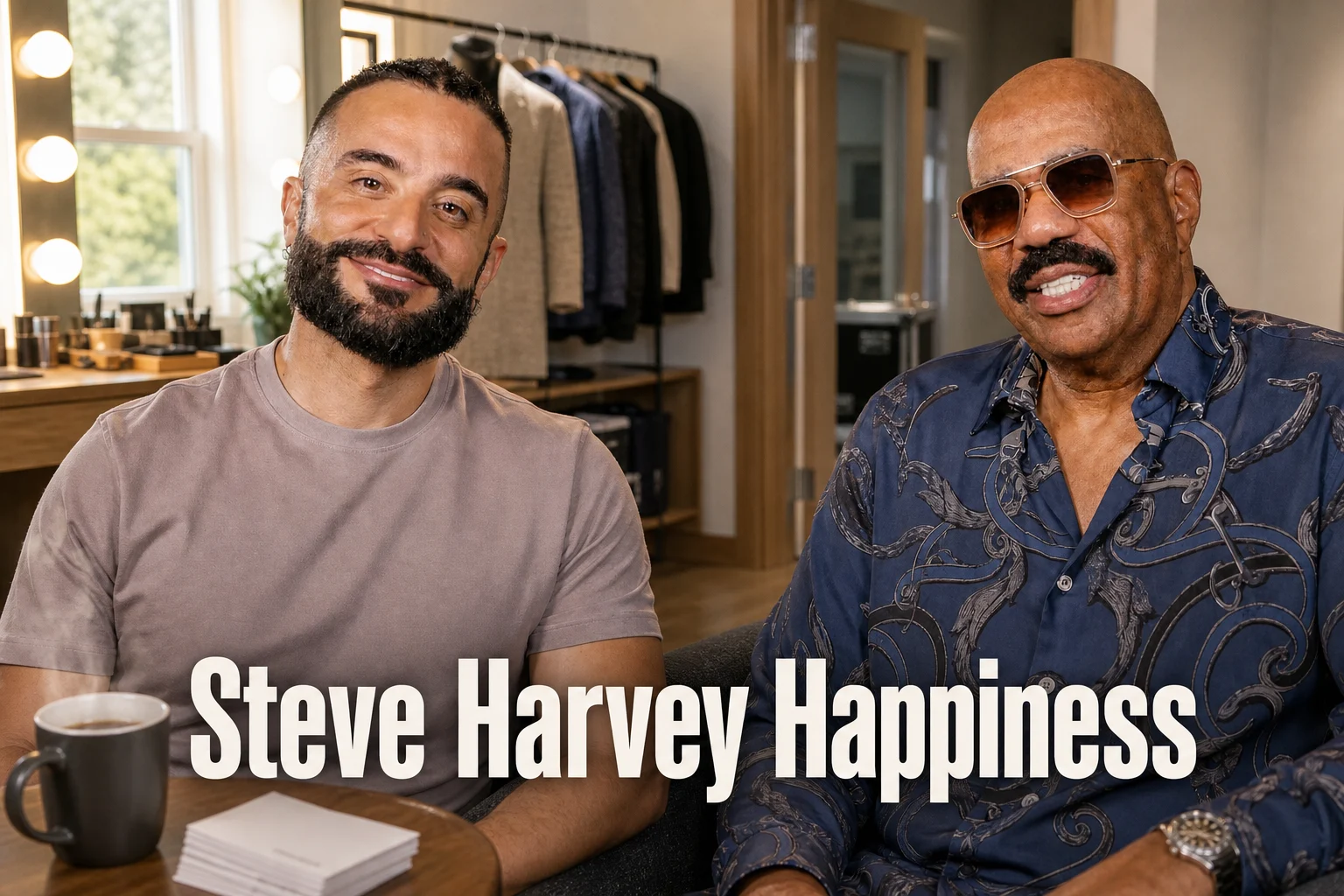
What actually makes Steve Harvey happy now
This article draws on our conversation with Steve Harvey.
Steve Harvey says happiness stopped looking like applause and started looking like other people smiling because of something he could do for them. He ties that feeling to family, to providing, and to moments where the room is full and the joy on other people’s faces matters more to him than being the one celebrated.
He makes that answer concrete fast. Steve Harvey says he celebrated his birthday for the first time this year only because his wife insisted (19:33), and the surprise for him was that the pleasure did not come from being honored. It came from seeing friends and family happy together.
Why does family happiness matter more to him than his own celebration?
Family happiness matters more to Harvey because he describes his own joy as something that shows up when the people he loves are taken care of and visibly happy. He does not frame happiness as a private feeling he chases alone. He frames it as a reaction to what he can create for his wife, his children, and the people close to him.
That is where his idea of success lands. Fame and money are in the background, but the emotional payoff sits somewhere else. He says the real lift comes from looking at his children’s faces or his wife’s face after he has done something for them, which turns happiness into something active, almost practical. You can hear the standard he uses: not What did I get, but Who did I help, and what did that make possible in the room?
He connects that to men more broadly through a point he also made to Cedric the Entertainer. Men’s happiness, in his telling, is often tied to their ability to provide for other people. That is why, he says, Father’s Day does not carry the same cultural feeling as Mother’s Day. He is not talking about gifts or attention as the measure. He is talking about how many men attach their peace, pride, and even identity to whether they can do for others.
So the shape of Steve Harvey happiness is outward-facing. The center of it is not solitude, status, or self-congratulation. It is usefulness inside the family, and the feeling that the people around him are secure, enjoying themselves, and glad he is there.
What did his birthday finally teach him about happiness?
His birthday taught Harvey that being celebrated was not the point; seeing everyone else enjoy themselves was. The event mattered because it exposed a gap between what people assume should make a famous man happy and what actually did.
He says his wife pushed the celebration, not him, and the thing he took from it was the sight of loved ones having a good time together. That turns the story from a party anecdote into a statement about what he values now. A birthday should be the most self-focused kind of occasion. In his telling, even that became about the pleasure of hosting joy rather than receiving it.
He gives another detail that sharpens the point: his first birthday party ever was at my 60th, on a yacht out of the country with all his kids and a few very close friends (20:52). The setting sounds big, but the part he stresses is not the yacht. It is who was there. All his kids. A small circle. People who count.
That helps explain the difference between spectacle and happiness in his version of the story. The expensive backdrop is almost incidental. What stayed with him was the room, or in this case the boat, filled with the people he most wanted near him. For a man whose public life has been huge for decades, the emotional unit is still small: wife, children, a few close friends.
And that is why the birthday lands as more than a late first party. It is evidence that his happiness has narrowed in the best sense. Not smaller emotionally, but more exact. He seems to know where it lives now.
Why does a cake tell you so much about Steve Harvey happiness?
A German chocolate cake tells you a lot because Harvey uses it to connect happiness with care, memory, and being known by the people closest to him. The story is domestic, ordinary, and very specific, which is exactly why it says more than a broad speech about gratitude would.
“It’s the best cake on planet Earth.”
— Steve Harvey (21:12)
He says his mother used to make him that cake and ship it to him wherever he was. After she died when he was 40 (21:25), the cake disappeared from his life too. Then he married Marjorie, and her mother had the exact same recipe. In his telling, that is not a throwaway coincidence. It is a family thread getting picked back up.
The cake matters because it carries the kind of happiness he keeps describing: love made visible through doing something for somebody. His mother did not just remember what he liked. She made it, packed it, and sent it wherever he was. Later, the same comfort returned through marriage and another mother’s kitchen. The joy is tied to people expressing care in tangible ways.
That also explains why Steve Harvey happiness keeps circling back to provision and family rather than ego. Even in a story where he is the one receiving, the meaning sits in the relationship. Somebody knew him well enough to make the exact thing that made him feel at home. Somebody cared enough to send it. Somebody else brought that feeling back after loss.
By the end, his answer is plain. Happiness, for him, is not the spotlight. It is the face across from him, the children gathered close, the wife who insists on a celebration, and the old family care that keeps finding its way back.
Listen to the full episode
Listen to the full conversation on Spotify — the episode goes further than any article can, and following the show means you catch the next one.
 Watch this episode on YouTube ·
  Listen on Spotify · Subscribe to One On One with Kris Fade
Links from this episode
Mentioned in the episode. Some of these may be affiliate or sponsored links.
This content was created with the help of AI (Antradus AI - gpt-5.4).