
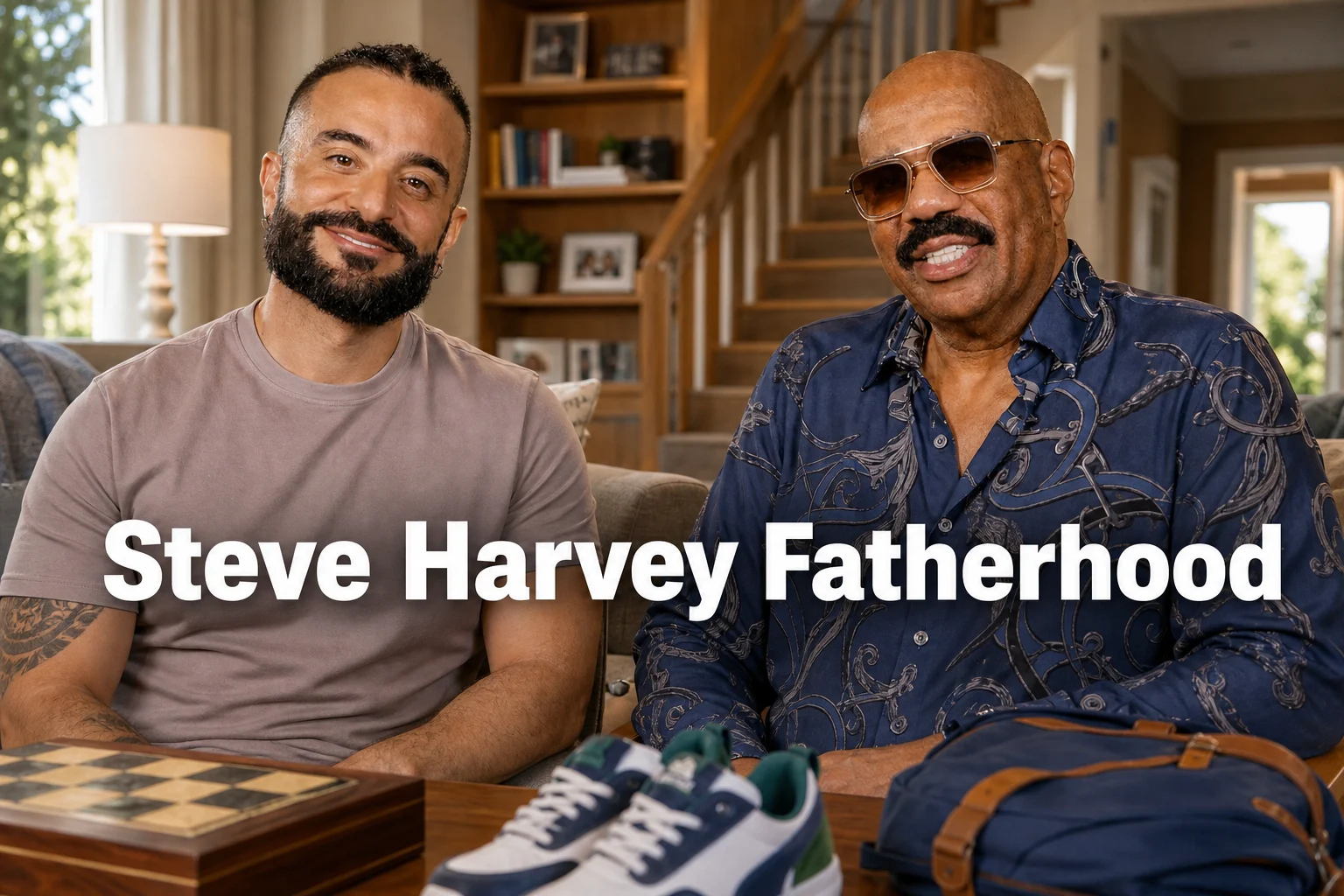
How Steve Harvey changed as a father after raising sons the hard way
This article draws on our conversation with Steve Harvey.
Steve Harvey says he changed as a father when he stopped treating his sons like one unit and started dealing with each child as a separate person with different needs.
He ties that change to regret. He says he spent too long trying to raise his boys through the same hard rules he came up under, then learned that fatherhood changed when the child in front of him changed.
Why did Steve Harvey regret the way he raised his sons?
Steve Harvey says the mistake was simple and serious: he grouped his sons together instead of learning who each one was on his own. In his account, that made him slow to see that one approach would not reach every boy the same way, even inside the same family.
He connects that regret to the world that shaped him. He describes growing up scrapping, walking across gang territories to get to school, and learning to deal with conflict in a time when fights were settled with fists, sticks, or bats instead of somebody pulling a gun right away. That background gave him a hard frame for what boys needed.
“That line going to get blurred.”
— Steve Harvey (8:46)
The line he is talking about is the one between toughness that prepares a son for life and toughness that keeps a father from seeing the son clearly. His account is not that discipline was wrong. His account is that sameness was wrong. He says he kept trying to teach his sons through that same lens for too long, and the correction came when he started building individual relationships with them instead of parenting them as a group.
That is the real shift in the story. A hard childhood did not disappear, but it stopped being the only template. For readers looking at Steve Harvey fatherhood through that lens, the change was not softer rules for the sake of softness. It was a different read of what each son actually needed from his father.
How did he handle daughters differently?
He says he approached daughters with a gatekeeper mindset, where fathers and brothers make clear to boys that there is accountability around the girls in the family. In his telling, the standard starts with protection, but it is also about setting visible limits.
He points to two daughters, ages 16 and 14 (8:16), while explaining the difference. Boys, he says, can break up, ghost, or stop texting. Those things happen. But the boundary for him is physical harm, and he says a boy cannot put his hands on his daughter.
That is where the contrast with his sons becomes sharpest. With the boys, he talks about learning not to force the same treatment on every child. With daughters, he talks about a family perimeter. The men in the house are not there to control every teenage interaction; they are there so a young man knows there are consequences if he crosses certain lines.
For a reader trying to understand Steve Harvey fatherhood, this part of his account is less about sentiment than structure. He describes fathers and brothers as visible backstop figures. The message to boys is not mysterious. You can leave. You can stop calling. You cannot become violent and expect nobody to answer for it.
What changed in Steve Harvey fatherhood after those mistakes?
He says the lasting change was putting his wife and children ahead of himself and treating family as a line nobody gets to cross, at home or online. That principle covers both how he parents and how he reacts when outsiders come after the women in his family.
He says family is off limits online. He also says fake private accounts do not stop him from tracking down men who make derogatory comments about his wife or daughters. The point he makes is not about internet drama. It is about responsibility. In his view, being a man in a family means you do not sit back and act detached when somebody disrespects the people under your care.
He broadens that into a rule for men like him. A husband and father cannot place himself ahead of his wife and children. That is the end point of the change he describes: less ego, more duty. The earlier mistake with his sons came from assuming his own experience was the measure for everybody else. The later principle flips that around. The man is not first. The family is.
Listen to the full episode
Listen to the full conversation on Spotify — the episode goes further than any article can, and following the show means you catch the next one.
 Watch this episode on YouTube ·
  Listen on Spotify · Subscribe to One On One with Kris Fade
Links from this episode
Mentioned in the episode. Some of these may be affiliate or sponsored links.
This content was created with the help of AI (Antradus AI - gpt-5.4).