
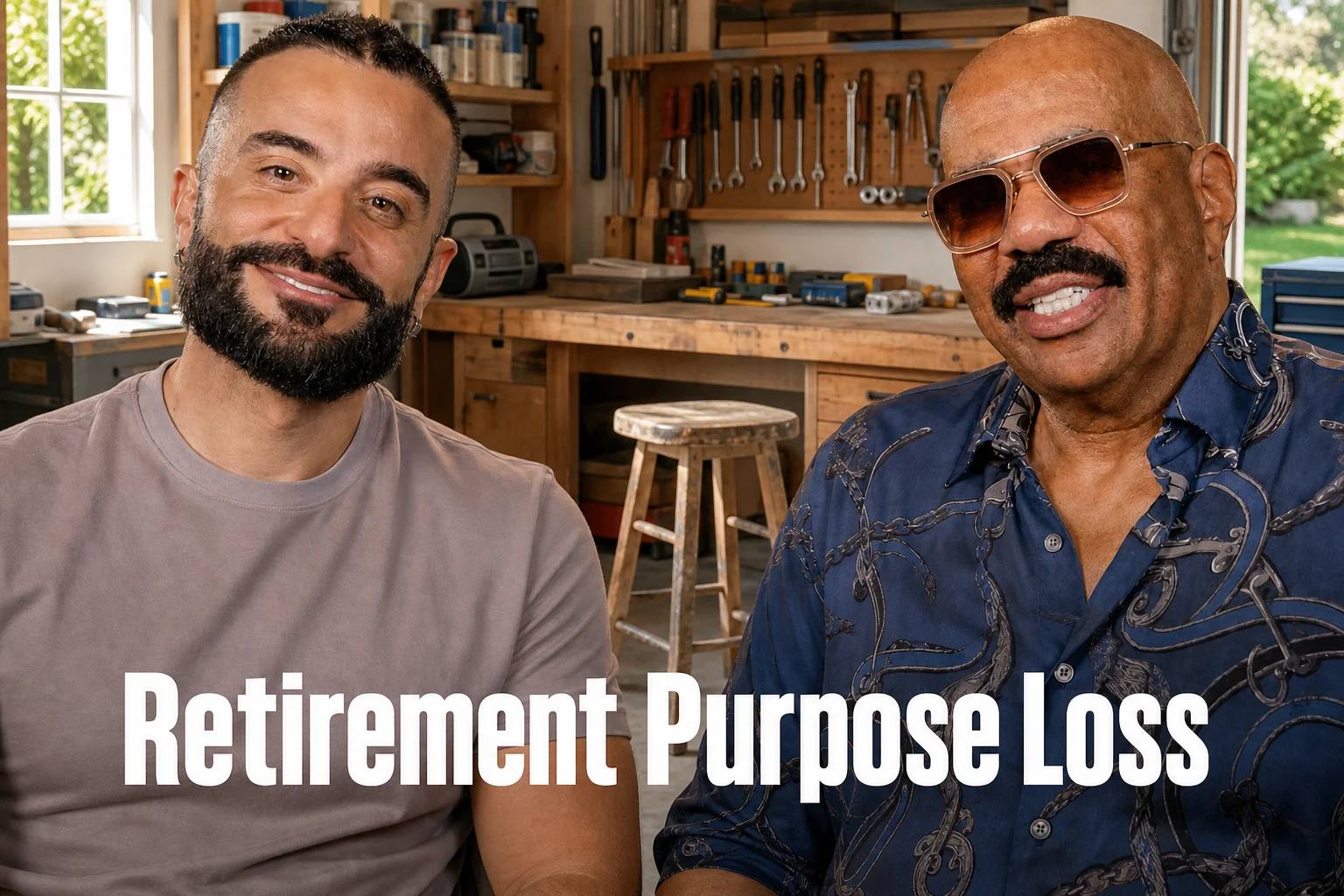
Why Steve Harvey says retirement can make people wither away
This article draws on our conversation with Steve Harvey.
Steve Harvey says people wither after retirement when work ends but purpose doesn’t replace it. He draws the line between a career that pays you and a calling that gives you a reason to get up, and he says losing that reason is where decline starts.
He ties that argument to a very concrete frame: 40 years in the business, a mother who was a Sunday school teacher for 40 years, and a life he now describes as driven less by money than by duty.
Why does Steve Harvey think retirement makes people wither away?
Steve Harvey says the danger in retirement is not rest but emptiness, because a person who stops working without finding a mission can lose the dream or vision that used to pull them forward. He grounds that in a biblical idea, saying scripture teaches that a man without a dream or vision shall perish, and he uses that to explain why some people fade once the job title disappears.
His distinction is simple and sharp. A career is what you build to earn a living. A calling is the thing you believe you were put here to do. In Harvey’s telling, plenty of people prepare carefully for the first one and almost never ask hard questions about the second. Then retirement arrives, the schedule opens up, and what looked like freedom starts feeling like drift.
“Your career is what you paid for, your calling is what you made for.”
— Steve Harvey (24:00)
That is the center of his answer. He describes himself as no longer being in a career phase, where the main pressure is climbing, proving, and collecting checks. He says he is in the calling phase now. The issue, as he put it to Cedric the Entertainer, is not money anymore but purpose. That is why the idea of retirement, in his framework, cannot be just about stopping. If you stop without replacing structure with meaning, you do not get relief. You get erosion.
He frames that outlook through duration as well as belief. Harvey points to his own 40 years in the business, not as a victory lap, but as evidence that a long working life can keep changing shape. He also brings up his mother, who was a Sunday school teacher for 40 years, as part of the same picture: steady service over time, not a sprint toward an exit.
What does purpose look like in real life for Steve Harvey?
Purpose, in Steve Harvey’s account, looks like building something for boys from fatherless homes and staying in motion because other people need what you can fund and teach. Rather than talk about meaning as a feeling, he points to his mentoring camp and the programs around it as the practical form his calling takes.
He told Cedric the Entertainer that the camp is built around two ideas: the principles of manhood and how to make dreams come true. That pairing matters. He is not describing encouragement in the abstract. He is describing instruction, standards, and a path from ambition to action. In his view, purpose is not sitting around wondering what fulfills you. Purpose is having an assignment big enough that other people are affected if you quit.
That also explains why he rejects the idea that being financially set means the work is over. He says he needs to keep making money so he can keep sponsoring programs and doing things for kids. The money, in this part of his argument, is not the finish line. It is fuel for the calling.
“Son, the best thing you can do for poor people is not be one of them.”
— Steve Harvey (26:58)
He presents that line from his father as a working rule, not a slogan. If he wants to keep the camp going, keep opportunities open, and keep showing up for children who need structure, then he has to keep producing. So retirement, as Harvey describes it, would not just mean stepping back from a job. It would mean stepping back from obligations he still believes are his.
That is why his version of purpose has weight to it. It comes with bills, programs, and real names attached. It also comes with continuity. The same man who talks about 40 years in entertainment talks about service as something you stay with for decades, the way his mother stayed with Sunday school teaching.
How does the camp story explain Steve Harvey’s view of retirement and purpose?
The clearest example Steve Harvey gives is a boy from his camp who arrived struggling badly and left with a dream he could finally see as real. Harvey says the boy came to the camp about four years ago (24:35), and he also places it as 4-5 years ago (24:44), when the child was failing everything in school.
Then Harvey asked what the boy wanted to do. The answer was fly airplanes. From there, the story turns on exposure and direction. He connected the boy with a Delta pilot, got him onto a simulator, and gave him a way to experience the goal instead of just naming it. The result, as Harvey tells it, was a complete shift. The same boy who had been failing became a straight-A student once the dream had a shape and a path.
Three years later, Harvey says, that boy came back as the keynote speaker after flying a plane in himself (26:12). That is the example he uses when he talks about what a reason to get up can do. The camp was not only about keeping boys busy. It was about attaching discipline to a future they could picture.
And that loops back to the retirement question. Harvey’s claim is that people do not wither because they stopped drawing a paycheck. They wither because they stopped moving toward something. In his own life, the movement now sits in the calling: teaching manhood, helping boys turn dreams into plans, and keeping enough income coming in to support the work. A career can end. In his view, purpose cannot.
Listen to the full episode
Listen to the full conversation on Spotify — the episode goes further than any article can, and following the show means you catch the next one.
 Watch this episode on YouTube ·
  Listen on Spotify · Subscribe to One On One with Kris Fade
Links from this episode
Mentioned in the episode. Some of these may be affiliate or sponsored links.
This content was created with the help of AI (Antradus AI - gpt-5.4).